

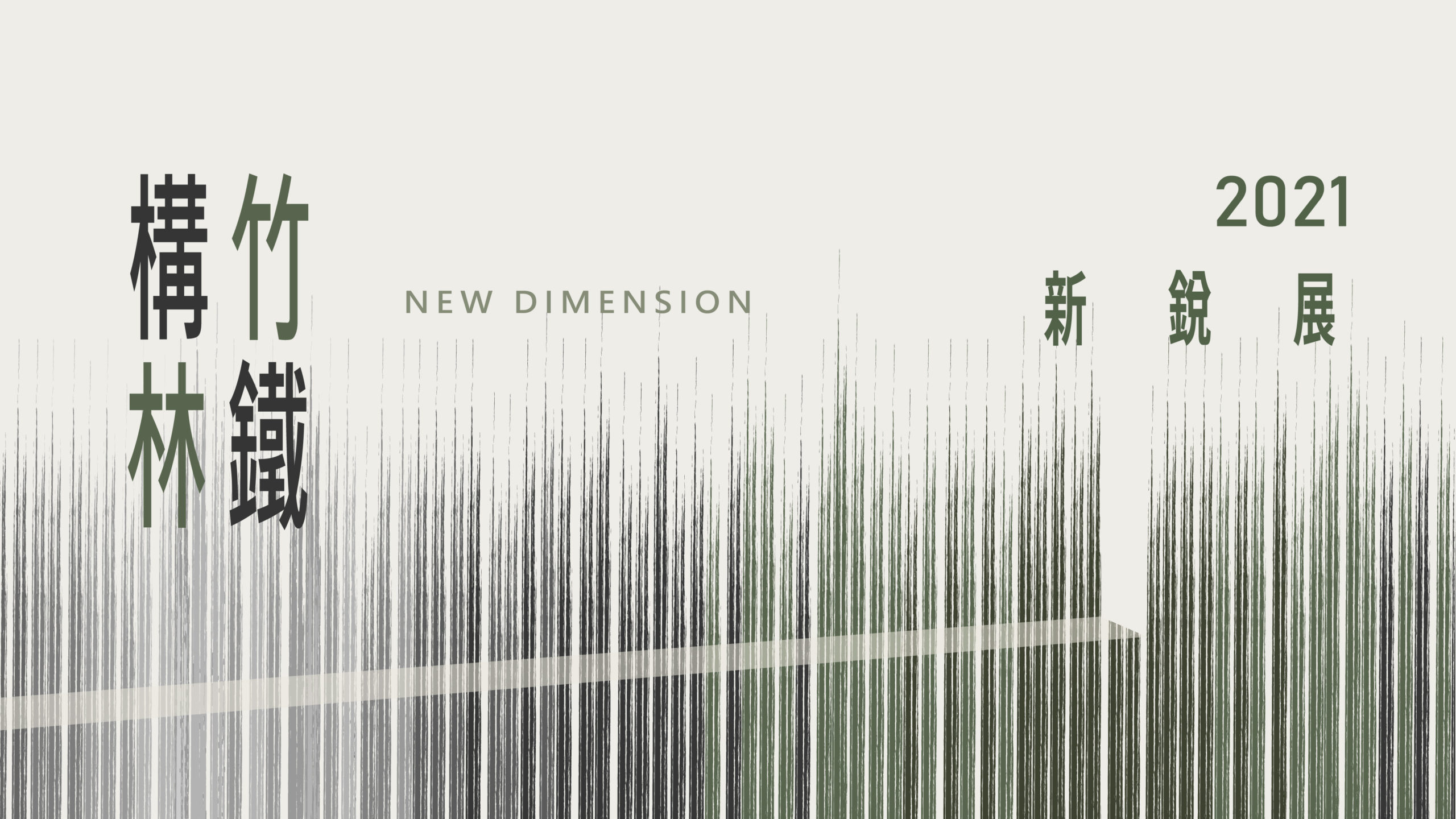
2021 "New Dimension" Exhibition of Emerging Artists at the Gouzhu Lin Railway
Taiwan needs to develop low-carbon construction and local building materials
Taiwan's uniquely blessed natural environment nurtures a large volume of high-quality bamboo, producing bamboo materials with a high degree of international competitiveness. Given that timber sources largely rely on imports and have a high carbon footprint, while bamboo surpasses trees in growth speed, carbon sequestration, and oxygen generation efficiency,The COVID-19 pandemic has also made countries around the world realize the importance of domestic timber and local production for local consumption. Bamboo can be harvested and used in just 3 to 4 years. Given the limited resources on Earth, imported timber raises concerns such as illegal logging and the sacrifice of other countries' environments, making it impossible to use with peace of mind. Choosing local materials is an urgent priority. To expand the imaginative applications of domestic bamboo, the "2021 Bamboo Architecture and Forestry Railway Emerging Exhibition," guided by the Forestry Bureau, curated by architects Kan Ming-Yuan and Li Lu-Chih of Taiwan Bamboo Society, and with structural engineer Chen Kuan-Fan serving as the curator, invited six industry architects and designers to use bamboo to create landscape structures that echo the surrounding texture of the Alishan Forest Railway. The exhibition officially opened on October 22, 2021.
Architect Kan Ming-yuan, Chairman of Taiwan Bamboo Society, who has dedicated many years to bamboo architectural design, stated
At a time when global environmental changes and sustainable ecological awareness are on the rise, biomaterials like bamboo deserve attention. In recent years, Southeast Asian countries have made significant breakthroughs in the development of bamboo architecture, driving their national images and related industries forward. Taiwan, possessing similarly excellent bamboo conditions, should emulate this spirit and develop its own unique approach.
Creation of natural bamboo structures: A new spatial dimension of structural mechanics
Curator Chen Guanfan explained,Through this exhibition, he hopes to break through traditional perceptions of bamboo and present new dimensions of its application. From an architectural structural perspective, he aims to inspire more architects to use bamboo as a starting point for their thinking. The ultimate goal is to create a “Bamboo-Structured City,” which is why the exhibition focuses on the integration of the city and bamboo.Chiayi is a natural city surrounded by forests and railways nestled among the mountains and woods. This exhibition aims to create landscape structures that resonate with the local culture and texture, inviting people to walk through the forest railway, experience the endless possibilities of bamboo structural mechanics, and discover a new spatial dimension (NEW DIMENSION).
The works of the six groups of architects in this project are located in the area traversed by the Alishan Forest Railway, which is rich in ecological resources and home to a variety of bamboo species ranging from tropical and warm-temperate to temperate zones. However, the use of bamboo presents unique challenges.Compared to wood, bamboo presents greater difficulties in design and fabrication due to its irregular shape, heterogeneous nature, and hollow structure—challenges that must be overcome.In addition to participating in a collaborative learning session on bamboo construction techniques this past February—where they gained an understanding of bamboo’s properties, the high-temperature drying process, and bending methods—the six teams of emerging architects held multiple discussions with curator and structural engineer Chen Guanfan to address and refine technical issues regarding the “weather resistance” and “durability” of their structures.
Meanwhile, six groups of up-and-coming architects have constructed public facilities using bamboo along the Forest Railway, creating spatial experiences that blend traditional spirit with modern thinking, while further expanding the possibilities for the application of domestically produced bamboo.May this wave of bamboo-structured design help bamboo regain the attention of the general public, and may the warmth and flexibility of bamboo serve to connect memories of the past with the landscapes of a new generation.
Event Information
In-Person Exhibition Area
Effective October 22, 2021
Alishan Forestry Park / Wednesdays through Sundays, 9:00 a.m.–5:00 p.m.
Chiayi Zhuzhi Station / Daily 9:00 a.m.–9:00 p.m.


Bamboo Architecture Model Exhibition & Taiwan Bamboo: The Trend
2021.10.22-2022.01.10
Chengyi Cultural Travel: Taocheng Tea Style / Daily 9:00 a.m.–9:00 p.m.


Alishan Forest Railway's Bamboo Architecture Scenery X 6 Groups of Architects
Time Tunnel—Designer Chen Yuwen
Journeying through a tunnel of intertwined light and shadow, the bygone imagery of tracks transporting timber slowly emerges. Travelers pick up those lost beautiful moments of the past, and historical fragments once left behind are gathered up once more. Through three types of arches, a stable structure is jointly woven, creating railway-like light and shadows that evoke memories of past prosperity. Using everyday materials and a novel construction method, it is hoped that land-friendly industries can be revitalized.
☛Bamboo Pavilion · Courtyard—Architect Wang Mingxian
Shade. Drawing inspiration from the conical hat, the design repurposes the traditional bracket system by interlocking bamboo to form the main structure. By bringing outdoor materials indoors, the boundary between interior and exterior is blurred, allowing the two spaces to interpenetrate and creating a layered aesthetic.This approach embodies the Japanese aesthetic of “in’ei” (shadow and light), where the beauty of layered vistas is revealed when viewed from the shadows outward. It provides a sense of psychological security while simultaneously embodying a sense of detached beauty that remains aloof from the mundane world.
☛Symbiosis—Peng Wenyuan, Architect
Zhuzhi Station was once the terminus and starting point of the mountain section of the forest railway, where locomotives had to turn around, creating a distinctive “triangular track.” The artwork is situated at this key junction of the railway route, and the station grounds serve as a bridge between the past and the future.Through the linearity of the bamboo grove and the mobility of the tracks, the artwork symbolizes the convergence of the forest railway’s historical trajectory with its future, while also evoking an image of soaring and rising—signifying the intertwining and mutual prosperity of the old and the new.
☛Pianpian—Architect Wang Zhe
Taiwan is home to a rich diversity of butterfly species, with Alishan alone hosting 194 species—nearly half of the total in Taiwan.This work transforms the imagery of butterflies fluttering in flight into an abstract space. Using bamboo structural panels in three different scales, it creates a layered, dancing trellis that integrates space and structure, featuring multiple atria—a place where people can rest, linger, admire the scenery, and enjoy themselves.It also demonstrates the potential applications and aesthetic possibilities of bamboo structures.
☛Bamboo Ripples—Architect Ye Yuxin
“Casting a line in the northern marsh on a mild, sunny day, with cypress logs strewn across the water’s surface before my eyes.” The former lumber mill’s log pond was also a living space for residents at the time and represents the collective memory of the timber industry. By creating a space here for people to linger,gaze, and reflect. By extending the curved form of the bamboo—like shimmering ripples on water—this design creates a resonant continuity that engages in a dialogue with the site’s temporal and spatial context, allowing the wind, light, and tree shade to coexist within it, blending with the viewer’s most primal senses.
☛Fairyland: Bamboo-Frame Mango Tea House—Designer Fang Xinqiao
A quiet, bamboo tea house, half-hidden and half-revealed, sits on a small hill, as if a Taiwanese mango had fallen into the embrace of the earth. In the sun-drenched square of the lumberyard, take a seat in the shade of the trees at the bamboo mango tea house, where the breeze blows...
With the cool, pleasant breeze and a cup of Chiayi Mountain Oolong tea, you’ll naturally find yourself in a magical realm that bridges the inner and outer worlds.
| Sponsored by:Forestry Bureau, Council of Agriculture, Executive Yuan
| Organizer: Taiwan Bamboo Association (incorporated association)
| Co-organizers:Alishan Forest Railway and Cultural Heritage Management Office、Chengyi Cultural Tourism Group
| Curated by:Prototype Structural Engineering Consultants, Ltd.