
Lu Jingzhi — Guangyi Handicrafts Cooperative, Jing Shan Enterprise Co., Ltd.
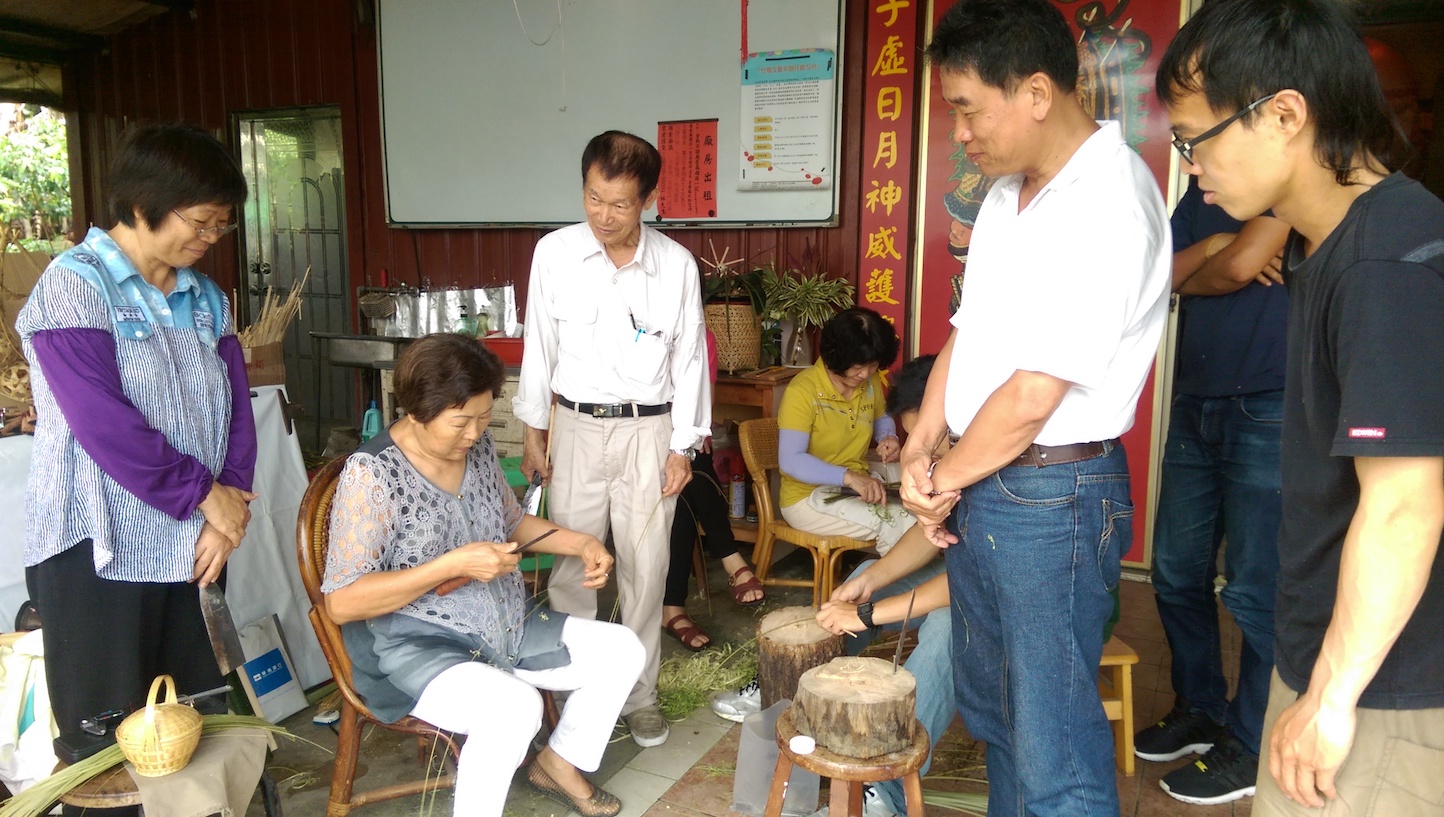
Lu Ching-chih, a bamboo craft artist from Guanhua District, Tainan City, was born in Guanhua District, Tainan City, in 1945 and is of Hokkien descent. She established "Guangyi Handicrafts" and "Jingshan Enterprise Co., Ltd.," which were important to Tainan's bamboo industry, and sold bamboo handicrafts such as fish traps and dustpans to the United States and Japan. After the decline of the bamboo industry, she dedicated herself to touring numerous bamboo craft study workshops throughout Taiwan. She is a Tainan City-designated preserver of the traditional art of bamboo weaving.
Lu Ching-chih, a bamboo craft artist from Guanhua District, Tainan City, was born in Guanhua District, Tainan City, in 1945 and is of Hokkien descent. She established "Guangyi Handicrafts" and "Jingshan Enterprise Co., Ltd.," which were important to Tainan's bamboo industry, and sold bamboo handicrafts such as fish traps and dustpans to the United States and Japan. After the decline of the bamboo industry, she dedicated herself to touring numerous bamboo craft study workshops throughout Taiwan. She is a Tainan City-designated preserver of the traditional art of bamboo weaving.
Lu Ching-chih was born into a family of bamboo weaving artisans, representing the fourth generation of her lineage. In her early years, her parents mainly made bamboo rice-washing baskets. Inheriting the craft during the booming period of the bamboo export industry, she excels in producing exquisite fine bamboo craft products. She established Kuang-Yi Handicrafts in 1966 and, along with her husband Chang Ping-shan, reorganized it into Ching-Shan Handicrafts in 1974. She is also the mother of the new-generation bamboo artisan Chang Yung-wang.
In 2015, the Cultural Affairs Bureau of Tainan City Government conducted oral history records of three major Tainan bamboo craftsmen, Lu Ching-chih, Mo Yung-chung, and Weng Ming-hui, and published them as "Long-woven Bamboo Dreams: Guanmiao Bamboo Weaving Craftsmen's Technique Album." In 2016, it additionally published her life history, "National Living Treasures Series 4 - Skillfully Weaving Auspicious Bamboo: The Life History of Lu Ching-chih."
The life of Lu Ching-chih
Lu Ching-chih was born in Guanmiao District, Tainan City, in 1945. Born into a family of bamboo weavers, she mastered exquisite bamboo weaving skills at a young age. In 1957, because she was too young to join the "Guanmiao Fine Bamboo Craft Technical Training Class"—co-organized by the village head and taught by her aunt Lu Lun—alongside her older sister Lu Ching-yueh, she began teaching herself bamboo weaving techniques.
In 1963, 18-year-old Lu Ching-chih helped a woman make a sample of a bamboo brooch and subsequently joined the company. However, after about three months, due to personal reasons, the woman handed over all the company's materials and tools to Lu Ching-chih. As a result, Lu and her older brother began searching for traders to sell the goods, and later established the "Guangyi Handicraft Workshop" to manufacture and export bamboo products.
Because Lu Ching-chih started by contacting traders to expand the bamboo products business, Kwang-I Handicraft was export-oriented from its inception. Compared to other companies of the same period, it had higher quality requirements and also set a higher price anchor for its products; therefore, it would handpick the makino bamboo used to make the products and choose different sources of bamboo materials according to different products.
In 1974, observing the rapid expansion of the bamboo industry market, Lu Ching-chih and her husband, Chang Ping-shan, reorganized Kuang-i Handicrafts into Ching-shan Handicrafts—the name "Ching-shan" combining characters from both of their given names. In 1976, it was reorganized again as Ching-shan Enterprise Co., Ltd. However, good times did not last. In the 1980s, Taiwan's bamboo industry gradually declined due to price-cutting competition from China and Southeast Asia, among other factors. Furthermore, a payment for a shipment of vegetable baskets sold to Japan could not be collected because the trader maliciously defaulted on the debt. As a result, Ching-shan stopped accepting export orders and subsequently went out of business.
According to Lu Ching-chih herself, although the business did not last long after the restructuring, Ching-shan's products at the time had fine craftsmanship and a higher unit price, resulting in very good revenue. She even stated directly, "Three boxes of our goods were more expensive than a whole container from other companies," which shows that the export market back then also placed great emphasis on craftsmanship.
After suffering from a trader's bankruptcy and default, Lu Ching-chih was invited to exhibit the products she had previously developed at the Tainan Library. Following her solo bamboo weaving exhibition in 1981, she began transitioning into teaching, serving as a bamboo art instructor in more than five institutions each year until 1989. From 1986 to 1992, she steadily served as an instructor for the bamboo weaving workshops at the Tainan County (City) Cultural Center and was invited to various exhibitions every year. In 1994, the Tainan County Cultural Center published her bamboo art monograph, *The Spring of Chang-chih-zai: Lu Ching-chih's Bamboo Art Monograph*, which documented her bamboo weaving techniques in writing for the first time for preservation and transmission.
Lu Ching-chih's teaching and heritage footprint spans all of Taiwan. In the single year of 1985 alone, he traveled back and forth between Taichung County, Nantou County, Changhua County, Tainan County, Kaohsiung County, Taitung County, and Japan to conduct teaching demonstrations, making him the bamboo artist with the widest teaching footprint among his peers. His bamboo art techniques have now been passed down to and are being perpetuated by his son, Chang Yung-wang.
(This article was assisted by the Tainan Bamboo Culture Foundation in field research.)