
Mo Yongchong
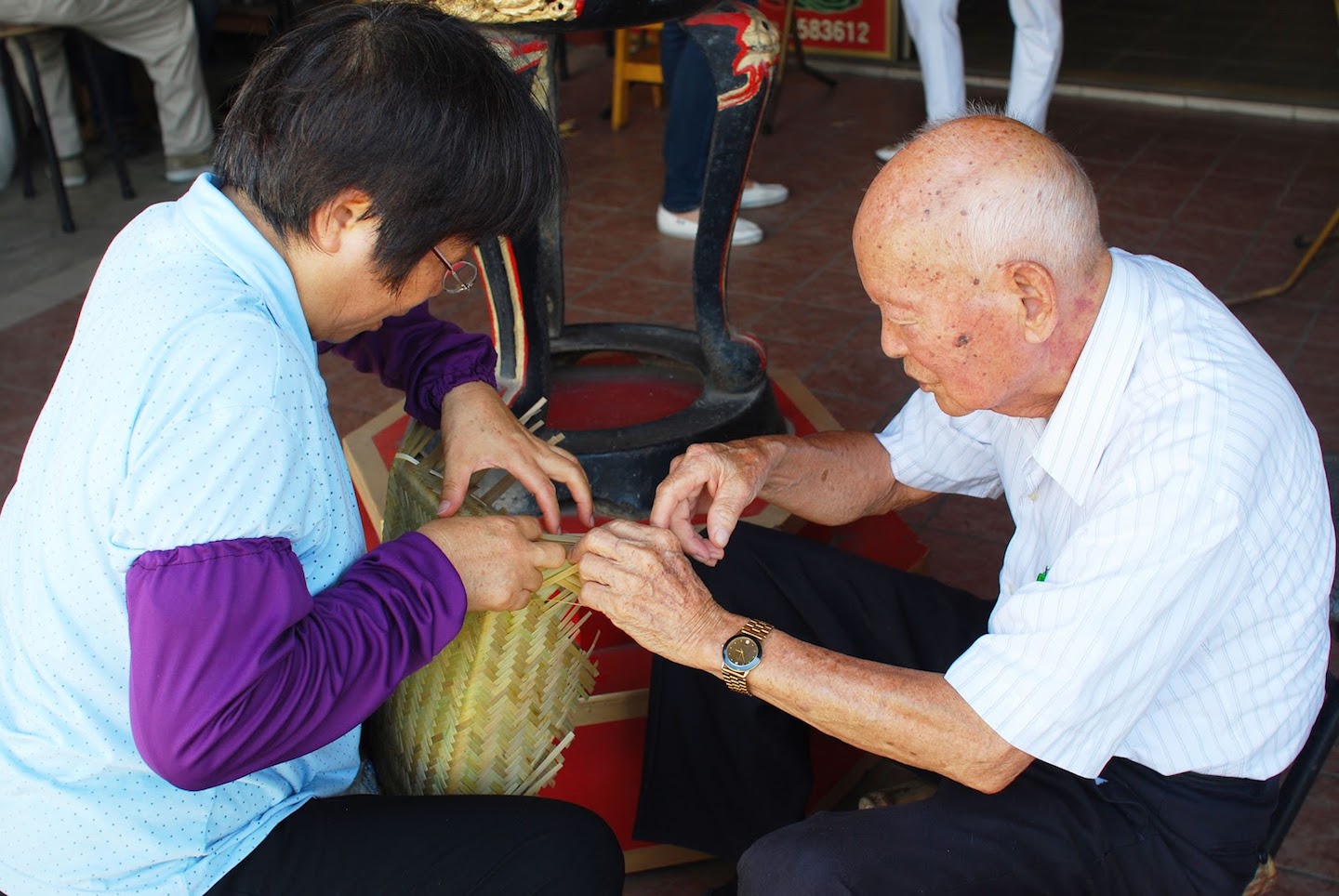
Mo Yung-chung is a bamboo craftsman from Guanhua District, Tainan City. Born in 1930 in Linnei Township, Yunlin County, he is of Hokkien descent and is proficient in bamboo weaving techniques. His journey of learning and practicing bamboo art spans across Taiwan. He is one of the few bamboo artisans trained at the Zhushan Commandery Bamboo Craft Training Center. Nearly a hundred of his craft pieces have been donated to organizations such as the Cultural Affairs Bureau of the Tainan City Government for preservation, and he is a designated preserver of the traditional art of bamboo weaving in Tainan City.
Mo Yung-chung is a bamboo craftsman from Guanhua District, Tainan City. Born in 1930 in Linnei Township, Yunlin County, he is of Hokkien descent and is proficient in bamboo weaving techniques. His journey of learning and practicing bamboo art spans across Taiwan. He is one of the few bamboo artisans trained at the Zhushan Commandery Bamboo Craft Training Center. Nearly a hundred of his craft pieces have been donated to organizations such as the Cultural Affairs Bureau of the Tainan City Government for preservation, and he is a designated preserver of the traditional art of bamboo weaving in Tainan City.
Similar to Huang Tu-shan, Mo Yong-chong's craftsmanship was rooted in the Zhushan District Bamboo Craft Training Center. Although originally from Yunlin and having learned his craft in Zhushan, Mo had been teaching and promoting bamboo weaving in Guanmiao District, Tainan City for many years after 1966. During the bamboo industry boom of the 1970s, because his innovations in bamboo products were widely popular in Europe, the Americas, and Japan, he focused on the export of bamboo products. After 1984, due to the decline of the industry, he returned to teaching.
In 2015, the Cultural Affairs Bureau of the Tainan City Government conducted oral history documentations of three major Tainan bamboo craft masters—Lu Ching-chi, Mo Yung-chung, and Weng Ming-hui—and published them as "Weaving Bamboo Dreams: Techniques of Guanmiao Bamboo Weaving Masters." In 2016, it additionally published his life history, "National Living Treasures Series 5: Perfect Bamboo Craft: The Life History of Mo Yung-chung."
The Life of Mo Yongchong
Mo Yung-chung was born in 1930 in Linnei Township, Yunlin County. His mother's family lived not far away in Zhushan Township, Nantou County, and made a living by selling bamboo shoots. His uncle split bamboo strips to make bamboo baskets for holding the shoots, which sparked Mo Yung-chung's interest in bamboo craft from a young age.
At the age of 14, encouraged by his father, Mo Yung-chong entered the Zhushan Commandery Bamboo Craft Training Center to study bamboo fine arts, under the guidance of early outstanding graduates Zhang Qingbo, Zhang Zhenjing, and Huang Man. At the age of 23, shortly after completing his military service and getting married, and with the full support of his family, he entered the Nantou County Special Exhibition Craft Research Class for further studies.
In 1960, guided by Huang Man, an instructor at the Zhushan Commandery Bamboo Craft Training Center, Mo Yong-chong was recommended for a position at the Taiwan Handicraft Promotion Center. He was assigned to Muzha, Xindian, Bade, Gongguan, Guanmiao, and other locations to assist in the development of the bamboo industry. Throughout this process, his family accompanied him as he traveled on assignment, and he finally settled in Guanmiao when he was dispatched to the "Guanmiao Experimental Factory" in 1966.
During his tenure at the Taiwan Handicraft Promotion Center, Mo Yong-chong primarily helped solve issues related to bamboo materials. He assisted factories in various regions in optimizing the production processes of bamboo products by introducing new machinery to process bamboo or directly purchasing raw materials, while also aiding in product development and prototyping.
After stationed at the Guanmiao Experimental Factory for 10 years, Mo Yung-chung resigned from the Taiwan Handicraft Promotion Center in 1976 to focus on the export business of bamboo woven products until the decline of the bamboo industry began in 1983. His bamboo woven exports were widely favored by the European, American, and Japanese markets.
Leveraging his past experience at the Taiwan Handicraft Promotion Center in the export market, Mo Yung-chong manufactures a variety of bamboo products in-house. By prioritizing the direct purchase of pre-processed bamboo and focusing intently on product development, he has earned widespread favor. Mo believes that maintaining the uniqueness of manufacturers and brands in the market is essential to sustaining profitability; consequently, he frequently takes on orders that other factories cannot produce, striving constantly for breakthroughs.
Between 1976 and 1983, Mo Yong-chong developed over 60 bamboo products. After 1984, he transitioned to teaching, serving as a technical instructor at Tainan Junior College of Home Economics (now Tainan University of Technology) and as a master artisan in traditional Chinese arts training classes. Following his transition to teaching, he was also honored with the Tainan County Magistrate's Award.
Also, after 1984, he successively donated his creations to the Taichung County Cultural Center, Tainan City Bureau of Cultural Affairs, Guiren Junior High School Fucheng Arts and Culture Center, and other locations for collection. Later, after Yu Zhishan paid him a proactive visit, recognizing his hardworking nature and high self-expectations, he took him in as a disciple.
In early 2015, due to sequelae from a car accident, Mo Yong-chong could no longer create bamboo crafts on his own and consequently retired. He believes that bamboo material processing is the most difficult part to pass on, but since his disciple Yu Zhi-shan has inherited his techniques, he is not worried that the bamboo craft will be lost in the future.
Spanning a creative career of over 70 years, Mo Yung-chung has donated nearly a hundred works to various institutions for permanent collection and has been invited to exhibit dozens of times by organizations everywhere. In 2010, Tainan City officially registered "Mo Yung-chung's Bamboo Weaving Craft" as a Tainan City designated traditional art, naming Mo Yung-chung as the traditional art preserver.
(This article was assisted by the Tainan Bamboo Culture Foundation in field research.)