# Built
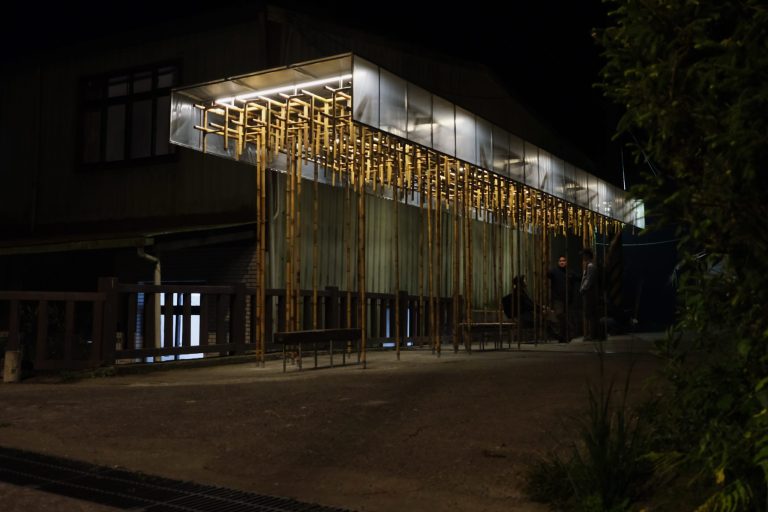
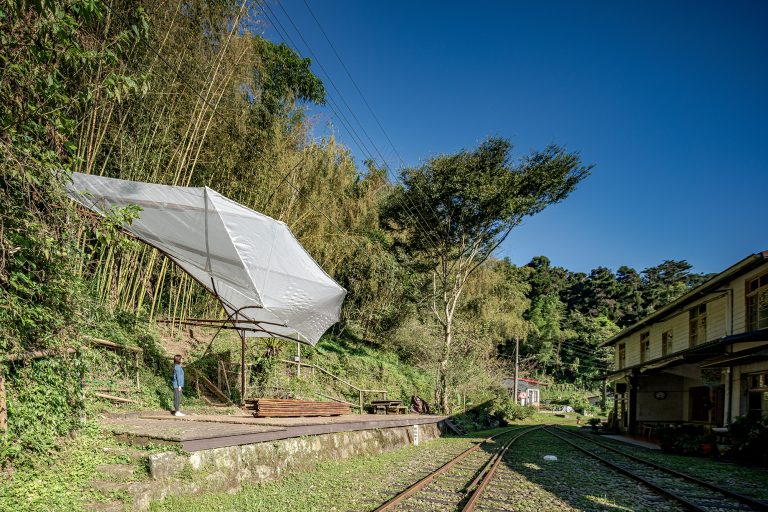
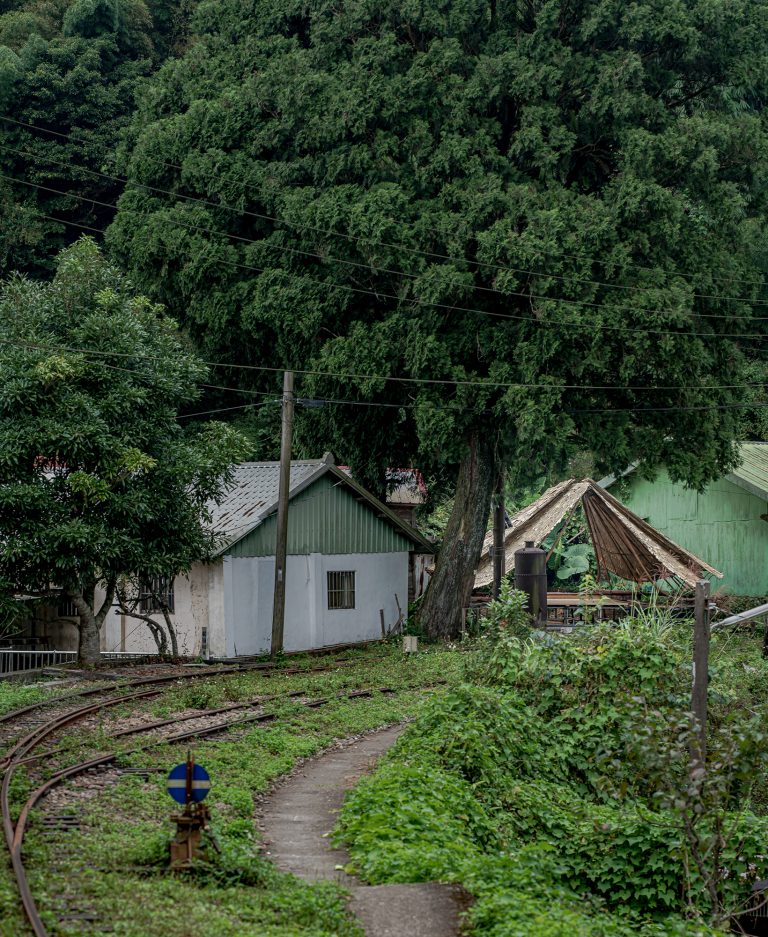
The design inspiration comes from the Alishan Forest Railway, with its bridges and tunnels weaving through the mountains.
Using a bamboo sandwich method to stabilize the structure, triangular interlocking stacks bring out the tortuous extension of the railway.
Like forestry railway bridges and tunnels, seemingly simple structures are full of hidden complexities, and simple materials can provide structural stability.
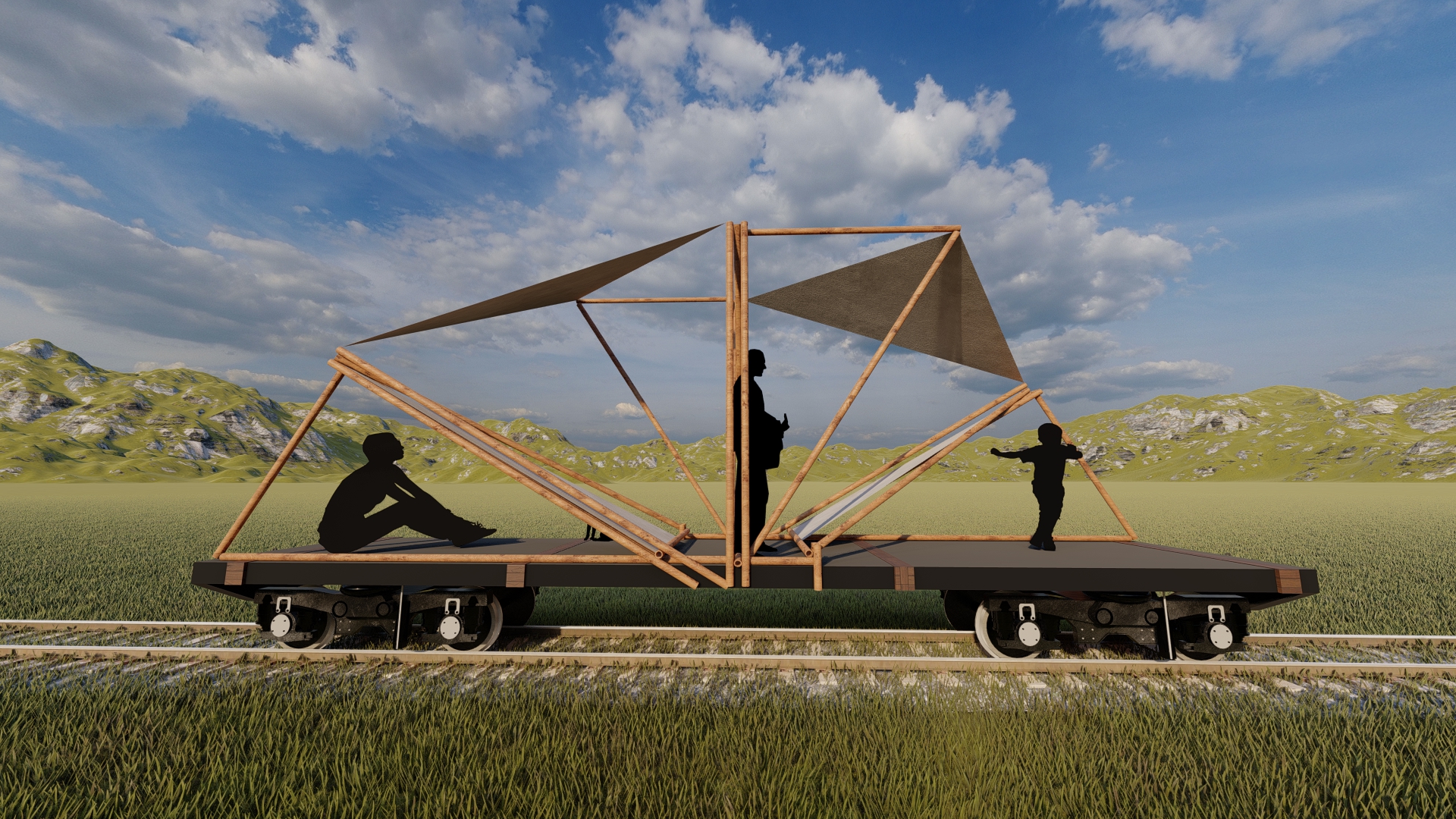
Starting from simple units, bamboo itself is a lightweight material, and we wanted to push it to its absolute limits. We created a simple component that can be quickly transported and assembled. By combining them using triangular structures, which offer balanced strength, we hope to simultaneously accommodate standing, lying down, and sitting, allowing for different ways of utilizing the space. Both setup and teardown are extremely convenient, enabling the transformation of the bamboo structure to be witnessed in the fastest possible way.
# Review
A common piece of advice is that it's fine to start simple, but within that simplicity, how do you maintain the interest that makes it enjoyable as a work of art? You might start simple, but try to break the original simple relationships and create something more fluid, for example.
The artwork is a framework composed mainly of triangles, with a center on the facade from which radial lines emerge, creating many triangles through rotation. If this center is not in the middle of the entire chassis, but offset to one side, the radial lines will produce uneven variations, allowing the piece to exhibit a less homogeneous order. Visually dominated by skeletal members, more elements can be added—whether as primary structures, or planes and enveloping elements added to support and define surfaces. These can be moderately increased to enhance the sense of an enclosed space. For example, adding more members and enclosed spaces on one side of the chassis while keeping the other side open as it is now adds playful spatial variety. I quite like how the work uses simple divisions to define the upper and lower sections: people can lie on the upper part, while children might play beneath the inclined plane. However, this is premised on the inclined plane being able to support human weight, meaning it may not simply be fabric, but could potentially be constructed with bamboo weaving for the surface, perhaps supported by a secondary structure.
Rapid assembly might be another challenge. Its morphological characteristic is having a fan-like center. Can it truly be like a fan, initially folded, with a rotating pivot so it can be unfolded? For example, everything could be prefabricated at the school, and a truck would transport the whole set to Zhuqi Station, where a very simple motion would open it up, requiring minimal assembly. If that can actually be achieved, that in itself is another challenge. (Hsu Pei-Hsien)
We could elaborate a bit more on some of the constructions. After all, the theme is bamboo, and starting with very simple elements is fine, but the amount of information we are getting is too small to understand the complete concept. Looking at the 3D model currently, there are quite a few issues that need to be resolved. Of course, the starting point is the interactive relationship between people and the installation, creating some spatial interest, but it doesn't seem to fully convey how the interaction works, how the structure of the installation arises in response, and how certain details are generated. (Chen Kuan-Fan)
All three groups use simple point-to-point connections, but with such a simple connection, you might need to express how you want to make the joint right at the connection point. Morphologically, due to the scale, the sense of volume feels rather thin. Is there an opportunity to achieve greater tension within this scale? Perhaps we can rely on adding members, the staggered effect of triangular units in different directions, or even canvas attachment methods. Is there a chance to treat the frame as one layer and the canvas as another, allowing for more interesting three-dimensional, staggered experiments between the two? Instead of having lines that are already very simple and just filling in color blocks inside the outlines, we could make the work feel more substantial through more interesting experimentation. (Fan Cheng-Tsung)