# Fireworks
Concept
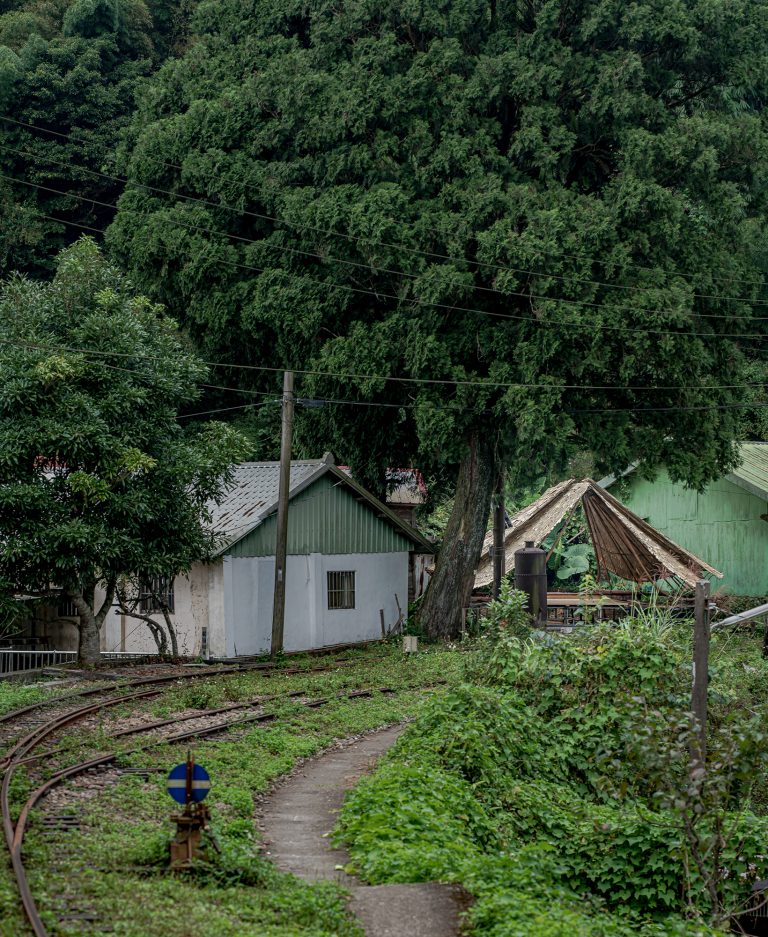
As the train billows thick smoke, crosses the iron bridge, and emerges from the bend. Like the long-awaited timber essential for survival, it is about to leave the forest at an altitude of 2,000 meters and become part of Chiayi's timber industry.This is the old memory of Zhuqi, and also the glorious era of forestry. Steam was a symbol of power, representing the fruits of a generation's sweat and hard work, or perhaps a part of everyday life. Today, forestry has become history, and how should Zhuqi, as an important node in the forest railway, respond?
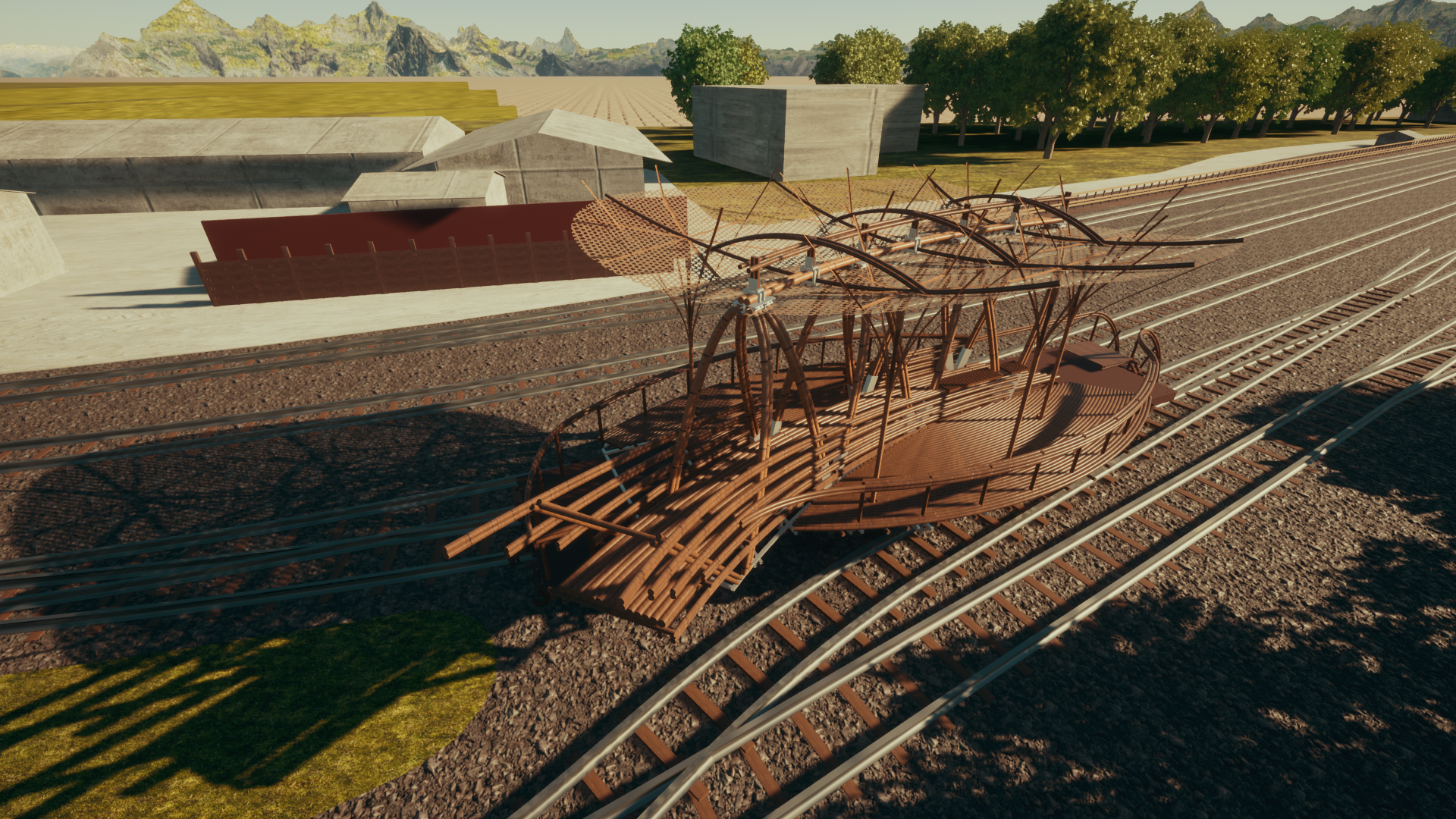
First Design Proposal - Wind Kinetic Sculpture
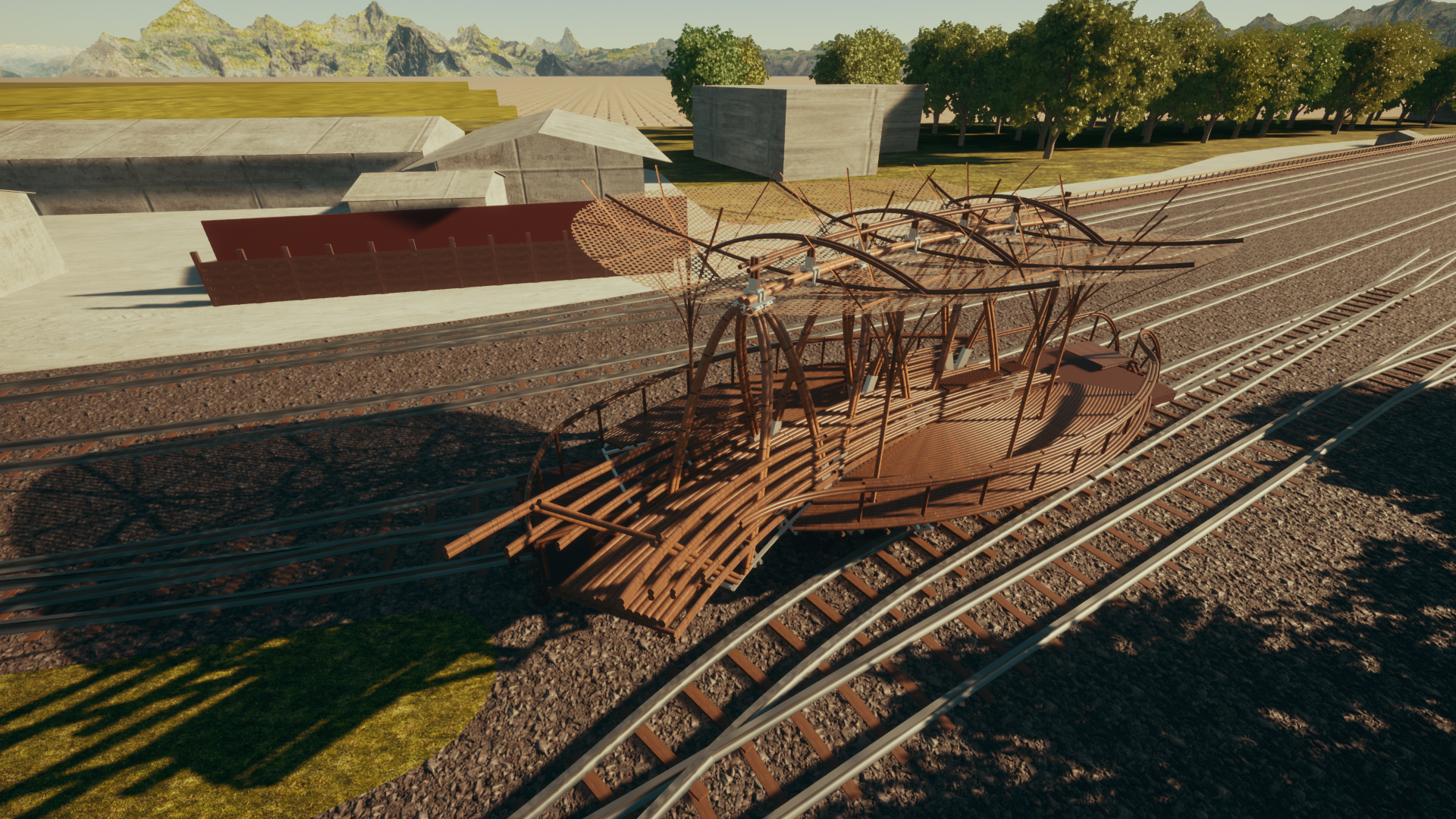
Using the leverage of the main structure driven by wind to generate vertical motion, which causes the blooming bamboo strips to expand and contract.
Resting on the bamboo deck, whether sitting or leaning, feeling the space shift along with the swinging arms, gives new vitality to the bamboo.
In terms of spatial layout, the use of axes and semi-arched bamboo structures responds to the environmental relationships of different orientations.
Design Change - Manual Mobilization Device
Generate deformation through human pedaling, pulleys, and cables.
Due to the change in the powertrain, we lightened the center spine structure to create a lighter roof.
Integrate the previously scattered surfaces to make the space more continuous.
Change the direction of the stairs to make the overall lines more continuous.


# Review
If you imagine the biggest difference between walking in a bamboo grove and walking in a forest, trees basically don't move, but walking in a bamboo grove, as long as there is a little wind, almost every bamboo stalk is moving. So I'm quite looking forward to the dynamics of this group; it's like they subtly presented the lightness, instability, and dynamic aspects of the bamboo grove. However, there are really too many other elements, so many that it's a bit overwhelming. They could be moderately reduced, leaving only the important parts. (Wang Wen-hsiung)
The structural framework of the work is interconnected, forming a stable expression. The roof is constructed of woven bamboo, but there are slightly too many elements, which can be appropriately simplified. Overall, it presents a relatively light and floating expression, which connects with the material characteristics of bamboo. (Kan Ming-Yuan)
The work has horizontal, vertical, roof, and many other directional units, but the relationships among the units seem like they could be handled more intricately and harmoniously to avoid ambiguous relationships between them that result in a distant view of what looks like a bundle of bamboo, leading to a somewhat chaotic visual. Aside from integration, perhaps creating a strong contrast and reworking the relationships between the elements would make the excellence stand out even more. (Fan Cheng-Tsung)
The design volume needs to be significantly reduced, and the reduction in scale comes with a reduction in design complexity. Reducing complexity is not a bad thing. It seemed like there was an ambition so strong that it couldn't be stopped, resulting in a lot of extra elements being added. Streamlining will actually benefit the overall design performance. If we do not expand it, the current relationship of two umbrellas overlapping might become somewhat troublesome. The umbrellas themselves would stick out quite a bit, and I am somewhat worried that practical constraints might make the design unexecutable. One possibility is to shift this overlapping relationship from the short side to the long side, which might make it relatively easier to maintain the basic composition we originally intended to do. For all three works, manipulations were made on the ground level where people walk. This is a good approach, but it will inevitably lead to a much larger overall workload. (Hsu Pei-Hsien)
At first, the intention was good—transitioning from smoke to wind, and then to a spatial structure. However, I care more about whether the wind-activated installation can be properly implemented, which will require quite a bit of effort later on. TNUA (Tainan National University of the Arts) is actually already very mature in such interpretation and construction; there is real technical expertise behind it. Since the student has chosen this theme, they can try to create something completely different and, if possible, interpret it using video first, because this kind of thing can be verified immediately once made, which is better than us discussing its rationality just by looking at drawings. Next, the student needs to focus well on implementation; structures that sway with the wind are difficult. (Chen Kuan-fan)