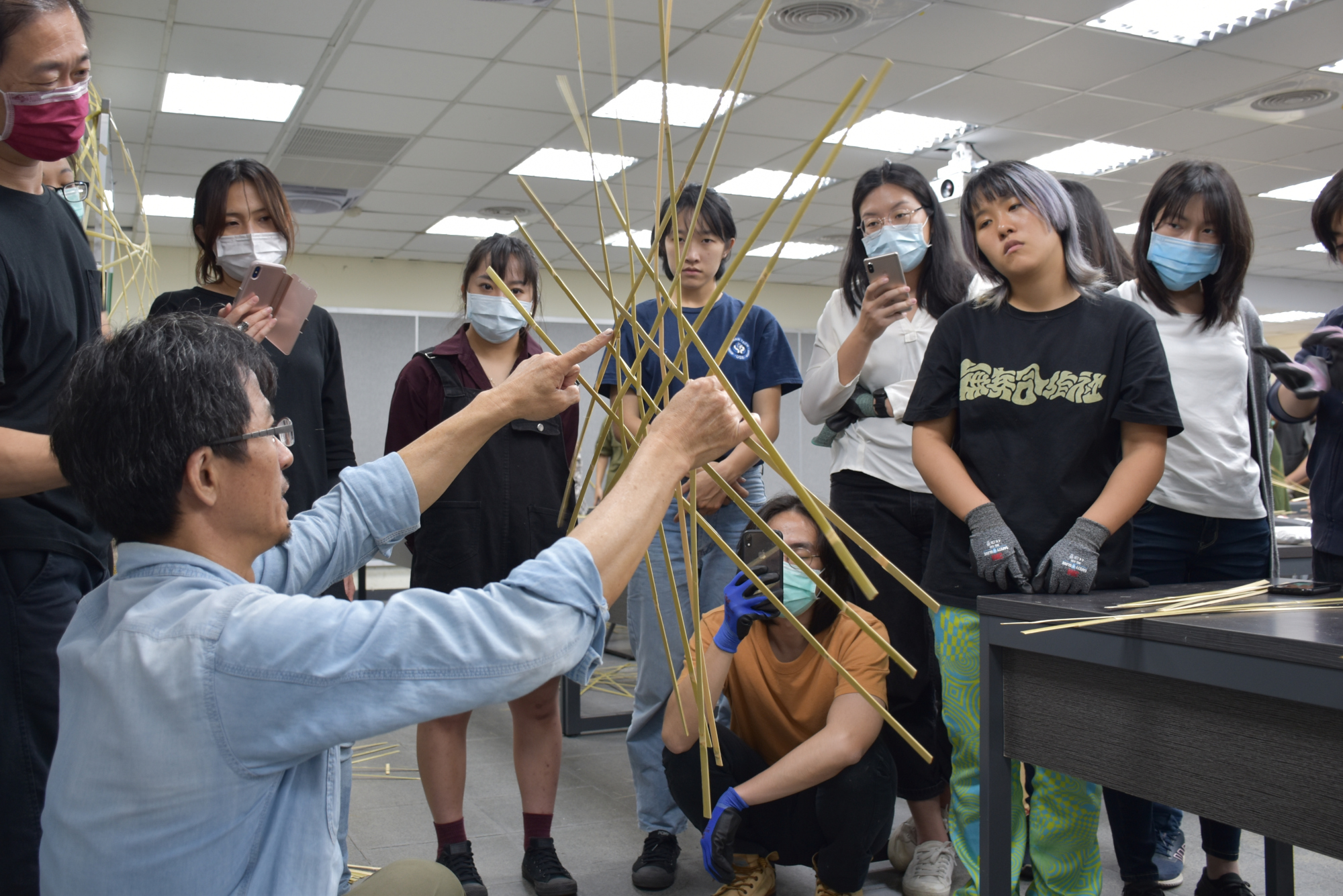
In addition to using bamboo tubes for structural support, weaving bamboo strips into flat surfaces is another element frequently used in conjunction with bamboo structures. We’ve invited Master Shi Zhicheng, a master of bamboo lacquer art, to teach everyone two commonly used basic bamboo weaving techniques: wheel-mouth weaving and hexagonal weaving.
Single-circle weaving
After completing the rim-weaving base, the center forms a circular hole, and the bamboo strips at the edge of the hole press against each other to form a single-direction swirl. What the students are practicing is the single-rim weave, and upon completion, the bamboo strips all follow an under-one, over-one relationship.
After forming one rim, the original flat surface is shaped into a sphere, and the bamboo strips are gathered on the opposite side of the sphere to form another rim. The whole body has two circular openings. In the history of Taiwan's bamboo industry, it was mainly used to make lanterns; in contemporary times, it is used for bottle decoration of flower vessels such as glass and ceramics.
I stood to the side taking photos and notes, and during a break, I decided to give it a try. What seemed like a simple, repetitive structure actually had an ingenious weaving sequence. I originally thought I could just follow the logic of alternating one over and one under, but before I even reached the eighth or ninth bamboo strip, my eyes were already swimming. It wasn't until I listened to the instructor explain the operational sequence that everything finally clicked. As it turns out, most of the time, bamboo weaving is actually woven, rather than just pressing and picking strips one by one.


Hexagonal weaving
The base starts with a hexagonal grid, and then expands outward, growing circle by circle to form a flat surface; or it can continuously extend in one direction to form a continuous wall.
The mutually pressed structure of hexagonal-woven bamboo strips forms a Star of David shape. It is the most widely applied and most frequently learned technique among all weaving methods, with numerous derivative weave forms such as pinwheel weaving and spiderweb weaving. It is also the one most commonly used to create patterns through the flower-threading technique.


Friends who are interested in bamboo weaving and would like to learn can refer to the newly published book by the National Taiwan Craft Research and Development InstituteIntroduction to Bamboo Craft Weaving Techniques。
The Bamboo Craft Workshop of the Craft Center's Technical Division has disassembled the weaving processes of 10 sets of bamboo artifacts, providing illustrated instructional explanations through aspects such as "basic flat weaving," "three-dimensional processing techniques," and "handle and rattan-wrapping finishing techniques." It is hoped that this will allow learners to explore step-by-step while achieving a sense of accomplishment upon completing the weaving. For those who already possess foundational skills, this booklet is as detailed as classroom notes, serving a function of reviewing the past to learn the new for quick reference, and can also be used as reference material for technical research or creative inspiration. There is no absolute standard for the technical booklet; readers can learn through comparison and reflection on the differences in techniques among various demonstrators, which will also be helpful for the future generation of their own personal insights.
Title|Introductory Guide to Weaving with Bamboo
Demonstration: Su-Ling Shih, Mei-Ru Lin, Su-Ying Tu, Ching-Chuang Kang, Yung-Sheng Chen, Shu-Hui Tseng, Kai-Ting Yu, Tsung-Yu Yang, Hsing-Tse Liu, Su-Jen Su (Ordered by surname stroke count)
Editors | Yang Tsung-yu, Yu Kai-ting
Copy Editor: Chien Chia-Yi
Photography | Phat Chu Studio
Translation | Katie Hayslip
Art | Haoxindi Cultural and Creative
Publisher | National Taiwan Craft Research and Development Institute
ISBN|978-986-532-265-6