# Bamboo Splitting Machine
Concept
Bamboo splitter is a circular device with 4/6/8/12 built-in steel blades. By aligning the device with the cross-section of the bamboo and applying downward force, the characteristics of the bamboo fibers and the device allow the tubular bamboo to be split into several strip-shaped bamboo pieces.Combining what was learned in the bamboo construction workshop to showcase the beauty of traditional craftsmanship.
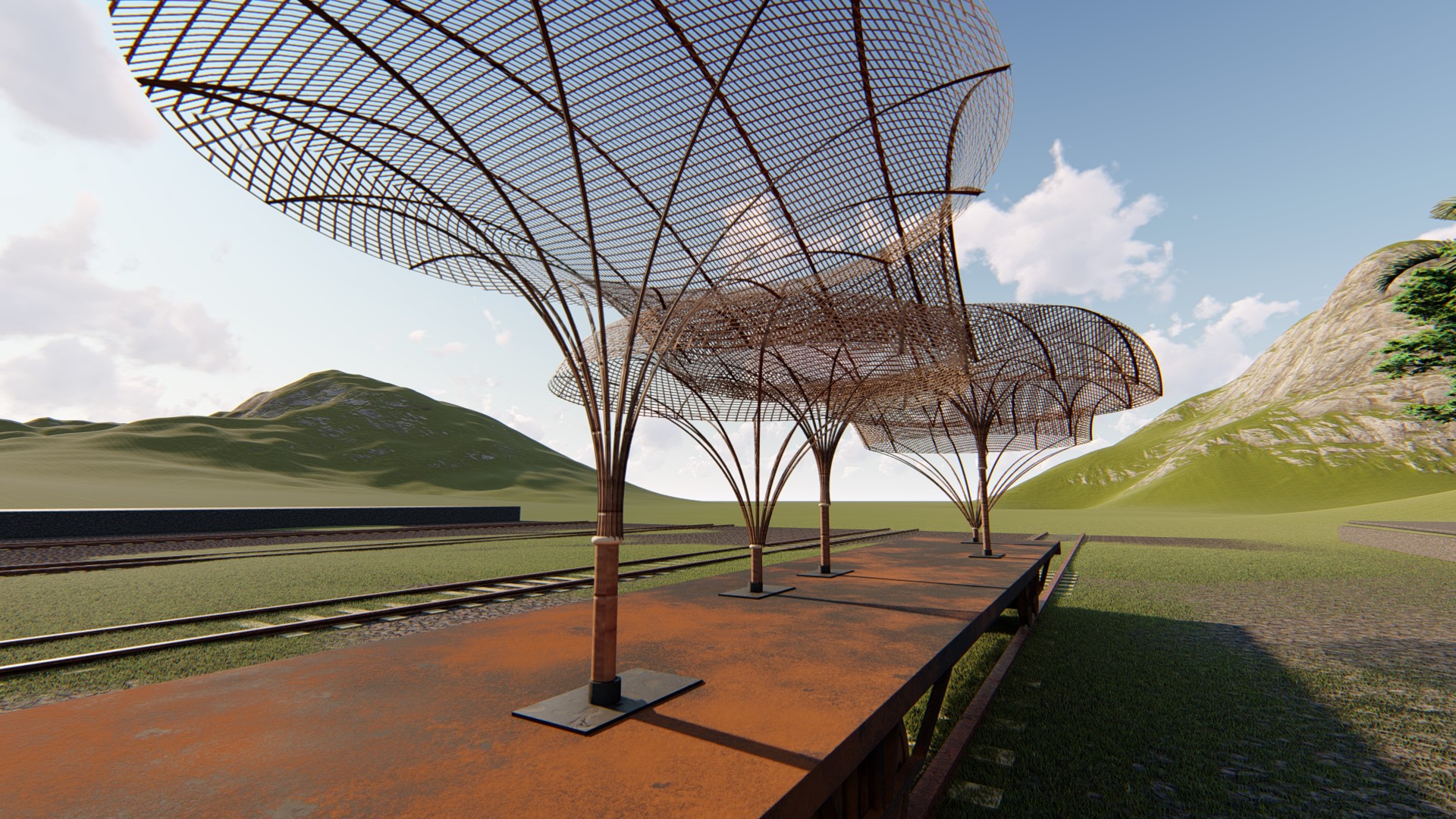
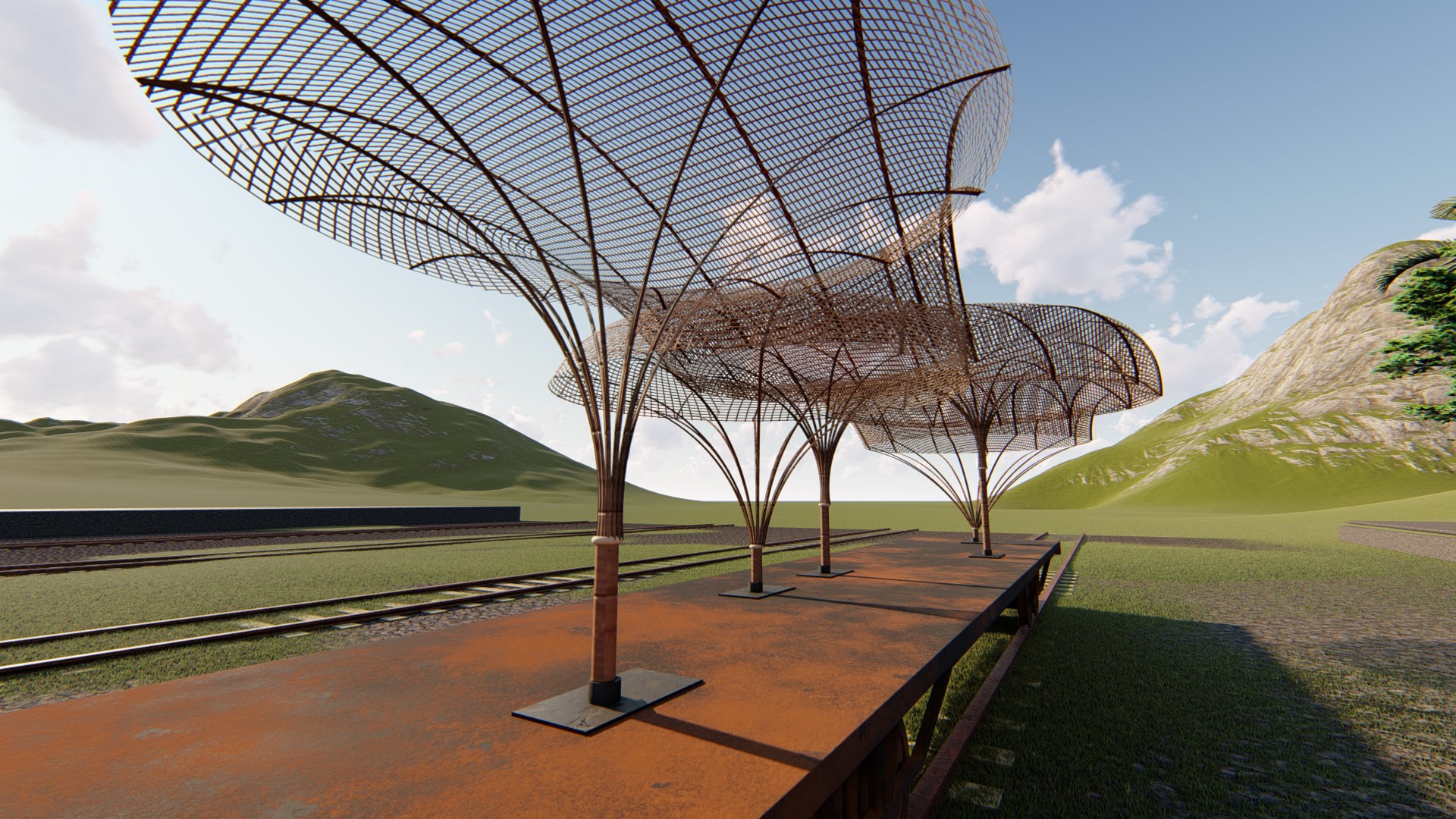
Use a bamboo splitter to cut the bamboo from a tubular to a sheet-like state, presenting both tubular and sheet-like states simultaneously. Use the splitting process to control the degree of spreading and the opening and closing of the bamboo strips. The nodes are fixed with 3D-printed fixators to position the separation angle of the bamboo strips, achieving the function of shaping.


# Review
The artwork utilizes the process of splitting bamboo into strips. Halfway through the split, components are added to fasten them together. Each pillar branches out from a single original piece of bamboo into the roof framework, and the dispersed joints are connected through large radii to create a sense of fluidity. This part can be experimented with further to make the flow even stronger. Beyond just connecting points, perhaps differences in elevation could also be utilized to enhance a stronger three-dimensionality. The fixing method of the base has caused some concern among everyone. Finally, when adding the weaving, could the weaving pattern be processed based on the lines extending upward? Rather than just being an additional outer layer that detaches from the dynamic of the artwork. After managing to arrange such wonderful dynamics in the lines, this pattern makes the lines blur and disappear. There is an opportunity to make it more interesting; once a key focus is grasped, all subsequent decisions must be handled with care so that the previously arranged elements do not disappear or become secondary. (Fan Cheng-Tsung)
This group used traditional techniques, and I think this holds innovation and potential for the future of bamboo. The artwork might not be fully expressed and has quite a few flaws, but I chose it because of its future potential—it has the potential to evolve into a completely new movement. For example, NCKU looks at things from a spatial perspective, more from an architectural angle, whereas this group genuinely looks at bamboo, starting from its tools and craftsmanship. This is no easy feat and is a highlight. Furthermore, they actually accumulated experience during the workshop, found this kind of relationship, and refined it into a space. In the future, there may be many things to overcome, such as the condition of the intertwined growth not being explained very clearly. Also, actions like binding, swaying, etc., need to be properly explained for the aforementioned potential to be realized. (Chen Kuan-Fan)
This kind of form is relatively common in products, and similar things made of thin bamboo can be seen at Japanese festivals. However, scaling it up still has its own visual appeal. Here is a suggestion for reference: right now, the mushrooms all face forward individually. You could try inverting a few of them—some standing upright and some upside down. This would create more curves and angles at the connection surfaces while still maintaining the same technique. This might allow for a more diverse and richer morphological presentation. (Wang Wen-hsiung)
This lightweight, floating effect resonates well with the characteristics of bamboo. However, I think this group has the highest technical difficulty. Splitting bamboo tubes into bamboo strips and unfolding them results in a very weak state. How to transform that state into a powerful presentation through different bamboo strip weaving methods is a huge technical challenge. I can hardly imagine the path to realizing this. If it can be made, it will be a significant breakthrough. It requires immense technical support behind it, along with the introduction of the structural principle of thin-shell concepts, to make it happen. The student category allows for a certain degree of experimentation to point out potential. But a balance must also be struck. If it is to be implemented, how can the breakthroughs be achieved? Can current resources support the realization of the design? These are the challenges that will be faced. (Gan Ming-Yuan)
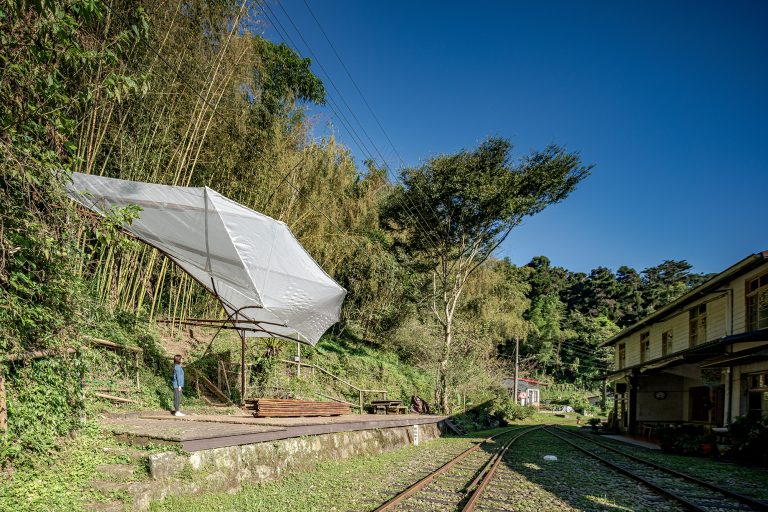
The work has a quite clear starting point, which is linking several umbrellas together to form a spatial structure. I like the ambition of the pieces from CYCU in terms of enclosing space. The difficulty of the umbrella-like shape lies in how to make each individual umbrella stand up. Even if they stand, they must be relatively close to the edge, transitioning members from the side fixing points to the flat plane. Splitting bamboo might be relatively conceptual rather than literally done that way, otherwise it would be very limited. That is, maintaining the characteristics of the umbrella shape, rather than using a single piece of bamboo and splitting it. One possibility is to use a bundle of bamboo like an umbrella shape, and then connect the umbrellas together, so that each umbrella must be able to stand stably, and then through mutual connection, they form a self-supporting framework. (Pei-Hsien Hsu)