#TRNO1
Concept
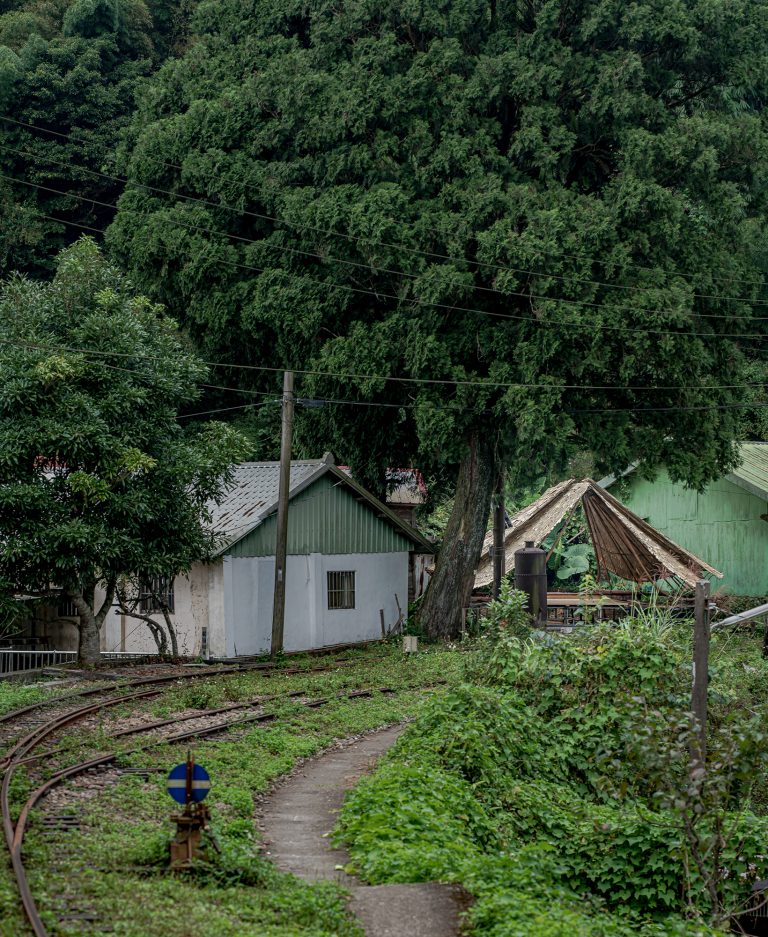
Before its development, Zhuqi was surrounded by bamboo forests. People navigated through the groves to reach their destinations. When the wind blew, the bamboo leaves rustled against each other, creating a sound accompanied by interlaced bamboo shadows cast under the sunlight.Enjoying the sounds within it and the shifting shadows under the sunlight can be said to be a shared memory for the local residents of Zhuqi.
The sound of bamboo, the shadows of bamboo, and triangular lines are very meaningful characteristics of Zhuqi. This design will also be based on the material of bamboo, combining it with these three elements to complete the creation of the artwork.
Morphological transformation
Centripetally converging triangular pyramids – The converging lines of history's movement
Bidirectional triangular pyramid – Change in front-end power
- Voice change
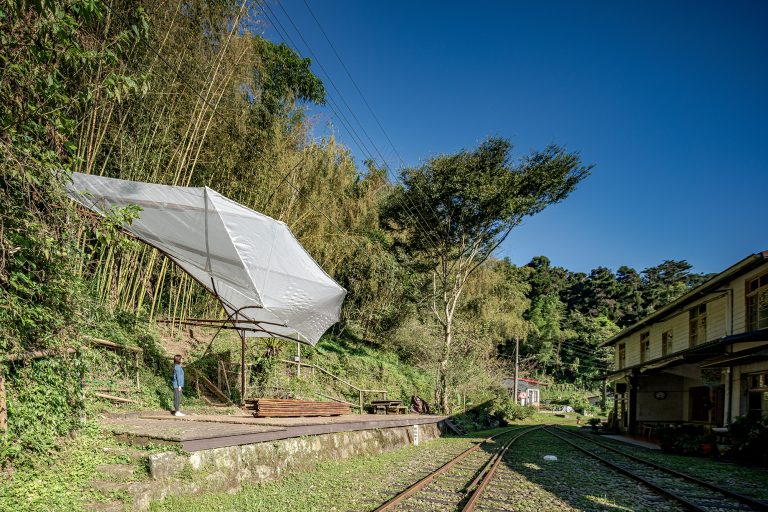
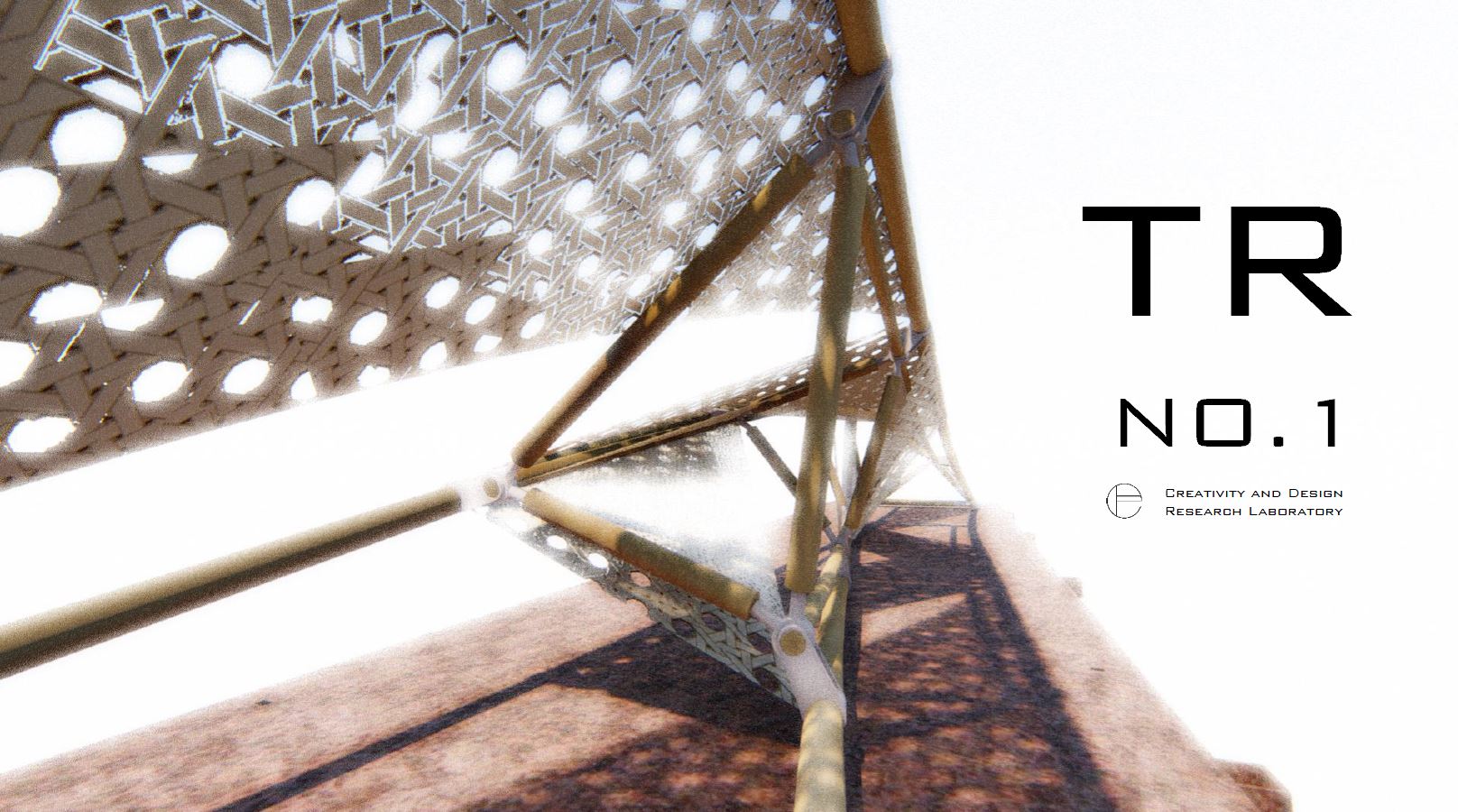
The sound of a bamboo forest is created by the striking of bamboo leaves against one another. The sound changes depending on the volume of the wind, with wind power creating fluctuations in pitch and volume, resulting in irregular variations using the same material. This design uses bamboo weaving to form surfaces between the framework. By utilizing the flexible characteristics of bamboo and the aid of hardware, the bamboo surfaces on the inner frame collide and friction against those on the outer frame, simulating the sound of bamboo leaves striking each other.
- Changes in light and shadow
Through the bamboo grove, the sun casts varying shadows through the small and large culms and leaves. By overlapping bamboo weaves with different pore sizes on the inner and outer layers, changes in light and shadow are created as the main structure sways.


# Review
The work attempts to use the sounds within the bamboo forest to form a shape, but the final presented form may not be easily associated with the original concept. I noticed that these middle bamboo poles undergo significant curves through tight tension. Although the forms are all straight elements, because bamboo has some elasticity, it is possible through dimensional tightness to make the straight lines less than completely straight. Such curves could be further enhanced to visualize the elastic tension of the bamboo, creating a feeling like drawing a bow and arrow, which would give the work more tension. Finally, adding a woven bamboo skin to the work results in a weaving pattern that looks large-scale with very strong patterned holes, which might steal the attraction of the key structure. This causes the development effort and the place where the most care was put into recede on the work instead, and the focus disappears. Therefore, it is suggested that the density or pattern of the bamboo weaving could be denser, or use other weaving methods, parallel lines, or simpler lines, or even a departure in color, so that the master-servant relationship of the weaving in the work can recede. Now that the edge contours have cut-out arcs, there is an opportunity to use these arcs to emphasize the structural force and flow direction of the work. (Fan Cheng-Tsung)
Bamboo fibers have very strong tensile strength, and I think the biggest difference between bamboo and wood is its elasticity, because it is hollow. The large-spanning curve in the middle allows us to more boldly and decisively challenge the possibilities of its bending across this span. Using bending as the theme, it is ultimately not even a closed form, yet it clearly conveys the bending characteristics of bamboo. Elasticity is a very important property of bamboo. After a typhoon, most bamboo forests are able to survive because of their exceptional flexibility. Is it possible for us to see this through your designs? (Wang Wen-hsiung)
The logic of the work is relatively clear. The main structure consists of three bamboo poles, twisted somewhat like a twisted cruller (youtiao), which land on the ground to form a Z-shape and should be able to stand on their own. If the 3D-printed joints can be successfully made, it will be a major highlight; the students may need some testing process, and if they can pull it off, it will be fantastic. Generally speaking, the space between every two poles forms a hyperboloid. It would be better to follow the characteristics of the hyperboloid: staggering the boundary angles and bridging many parallel bamboo pieces between the two boundaries to form a hyperboloid—a simple construction method that creates a stable curved surface. Furthermore, using bamboo weaving techniques to generate surface expressions, shadow changes, and other variations will help clarify the layers. Currently, a fair number of supporting triangles are placed in the middle; what originally looked like an angled eaves is now chopped up by several supporting triangles, and I would very much like to see space emerge. One possible approach is to reduce the number of triangles in the middle and rely mainly on the triangles at the boundaries to define the relative angles, the advantage being that it frees up the space in the middle. (Xu Bei-Xian)
The futuristic aspect of this work lies in how it utilizes a tension between a pattern and the subject, like bones and musculature forming a tightness, which is very unique. I also really like the interpretation of bamboo as a tubular structure, and how the bamboo is weakened into a thin skin, subsequently presenting a co-constructed relationship between the two, intersecting to welcome tunnel-like variations. From a structural perspective, because it features twisting and mutual restraint, if the skin and the framework are co-constructed, triangles are no longer necessary. It is already in a state of tension; if the internal triangles exist, the skin feels somewhat decorative. Therefore, it is suggested that this form and the primary-secondary relationship can be further refined. Remove the central triangular stand and use the skin to constrain and restrain it. (Chen Kuan-Fan)