#: The Sound of Bamboo, the Shadow of Architecture
Concept
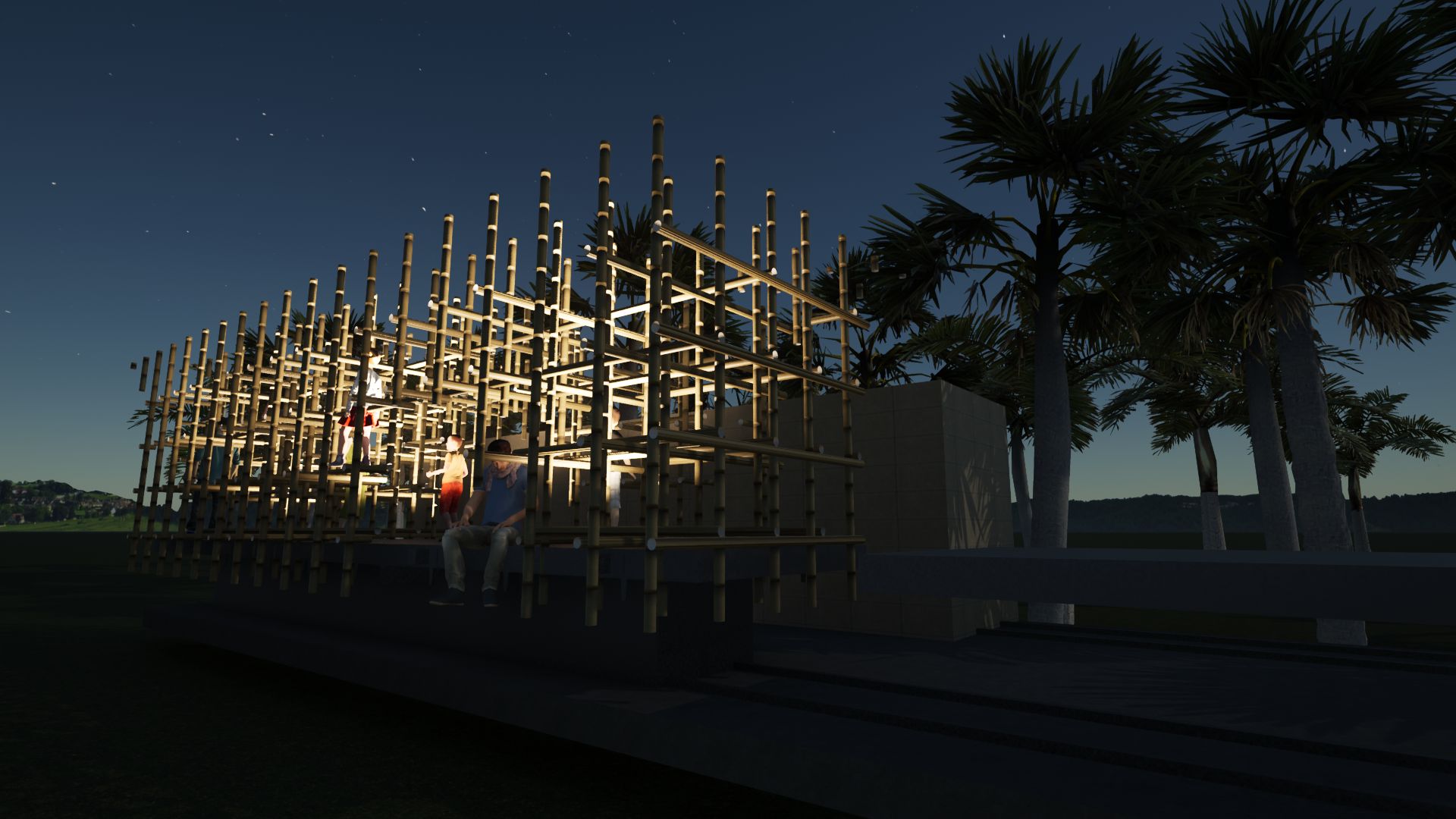
Design goals: A purely visual organic virtual space, challenging the interactive mechanism of emitting sound
Concept 1 - Incorporate curved elements into the interior of the installation by utilizing bamboo bending techniques
Concept Ideation 2: Triggering various activity formats through size constraints
Concept Ideation 3: Sound and Human Interaction Mechanisms: Wind, Human Power, Movement
Concept Generation 4: Vertical Phonation Method
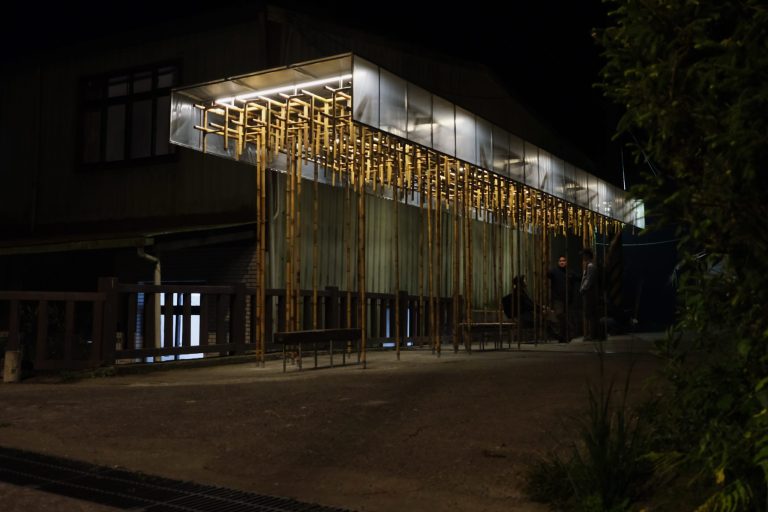
Concept Development 5 - Facade Design


# Review
I really like his concept, which is about human behavior upon entering this space and the spatial layout created by sound and shadows. The presentation starts with these charming sketches, including virtual spaces and sound interaction mechanisms, and even incorporates the concept of bending bamboo structures within the installation. It is fascinating how he uses behavioral interactions, the wind, and people to create a relationship that causes the bamboo structure to change. Developing ideas from this approach is wonderful.
However, unfortunately, the actions cannot be read from the presentation, only the intentions. It's unclear how this interaction of light, sound, and shadow actually works, and without seeing the physical composition, it's hard to envision what the final effect would be. Later, when discussing concrete implementation, it seemed to shift into a persistent desire to actually build it on the architecture, forgetting the sound interaction that was originally supposed to be challenged.
Also, regarding the bending we just talked about, I think it is a very romantic approach. I feel that how to integrate this into the theme you want to pursue is the key. So rather than a presentation like this, I would suggest this group shoot a video, presenting the message you want to convey through interactive sound. For instance, this section is great, as it interprets the interweaving and transformation of the void space and the bamboo structure, but for the viewer, what they most want to perceive is what kind of interaction is actually happening. (Chen Kuan-fan)
The work is somewhat like a children's climbing frame and is very attractive, especially some of the curved components. It would be even better if it could be considered together with the structural stability of the bamboo framework. Because we also have past experience with vertical and horizontal frameworks like this—although every joint was tied tightly with square lashings, the ability to resist deformation from horizontal forces was still not very good. If some curved components are added to produce an effect similar to diagonal bracing, the feasibility of the entire scheme would be very high, with the potential to form a climbing frame that children would really love. (Gan Ming-Yuan)
When viewed from the outside, the virtual space is a matrix. In this state, because it is transparent, the inner layer is visible. Perhaps the design of the virtual space could be refined further. One approach is to create a two-layer visual effect from the outside, featuring an interplay between empty and solid areas. Another approach is to make the virtual space more hidden and blend into the interior. More experimentation can be done to make the overall design simpler and more definite. (Fan Cheng-Tsung)
The work has that shadow of Sou Fujimoto (London Serpentine Gallery Pavilion project). Note that the act of carving must be done at a sufficiently high density to be highlighted; if the density is not high enough, you will see the individual objects themselves, which is the challenge of this project. How to make the act of carving visible and felt, or just see the space left behind. It seems ambitious not just to carve, but that the boundaries of the carving are shaped. One direction is to increase the density, and the other, which is a bit difficult to evaluate, is to add weaving inside. Two things later became less obvious: the curved bamboo and the bamboo weaving, which in the end seemed to appear only a little in the design. I am wondering if, to present the carving, having a layer of open-work weaving on the carved surface would make the act of carving more definite; this is one possibility. (Hsu Pei-Hsien)