Japanese bamboo fence / bamboo nail
Taught hands-on by National Bamboo Craft Master Liu Chao-ming, learn the art of making traditional Japanese bamboo fences,The operation process allows for practicing skills such as bamboo cutting, bamboo splitting, and knot tying. The knots, which look simple and elegant, are not so easy to learn.
In addition, we also learned the bamboo nail technique. We practiced using a bamboo splitting knife to split Moso bamboo into square-shaped bamboo nails, then drilled holes in the bamboo pieces to be joined. After driving the bamboo nails in, the excess parts were shaved off to complete the process. A student asked if disposable bamboo chopsticks could be used as bamboo nails, feeling that it could save a lot of work. However, the teacher's answer was that it is not a good idea. Does anyone know what the difference is? Stripping the bamboo skin off bamboo chopsticks causes them to lose their elasticity, and the diameter of the chopsticks remains almost uniform, unlike carved bamboo nails which have an appropriate thick-細diameter, so it cannot serve as a sturdy bamboo nail.


bamboo tube heat bending, fire curing
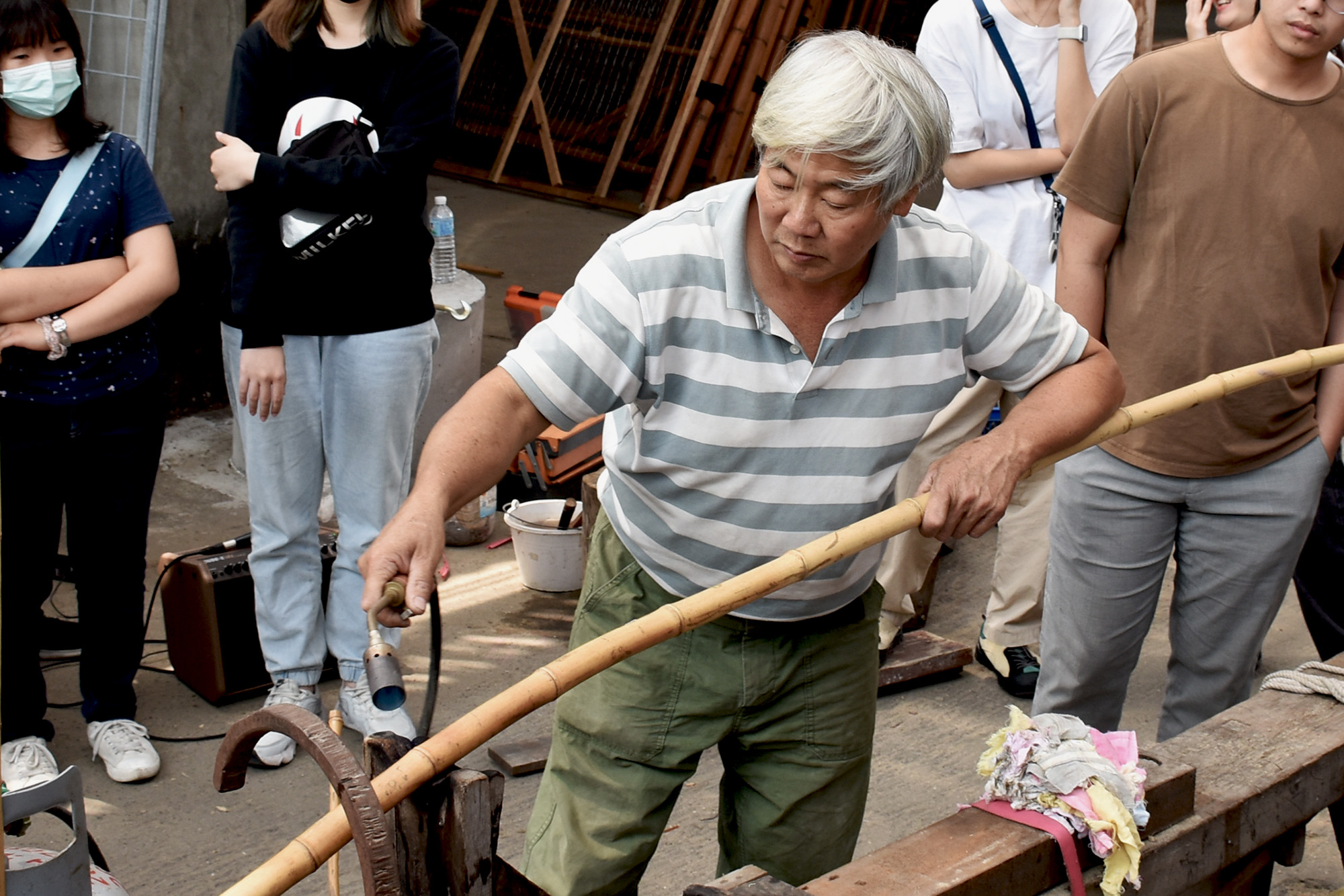
On the second day of the workshop, led by # Liu Zhaoming The teacher taught the method of bending bamboo poles with heat. Since the original state of bamboo poles is often not straight, whether the design calls for a straight or bent tube, "heating and bending" is a technique that must be learned.
Another exercise is fire curing. Unlike boiling, fire curing leaves the surface shinier, and the bamboo tubes become dense due to dehydration and shrinkage with more stable dimensions, making it a common treatment method for bamboo furniture. Fresh bamboo contains a lot of moisture, so if heated for too long at a single internode during fire curing, it will "pop" open with a bang, instantly releasing a rich aroma (?). An unforgettable learning experience.