
Did you know? Bamboo may have a history of use in Taiwan for hundreds of years!
Because bamboo, unlike metal objects, cannot be preserved for a long time, there is a lack of evidence to prove bamboo culture; however, the uses of bamboo may have already been developed several hundred years ago.
Taiwanese bamboo craftsmanship not only inherits traditions from China and Japan, but the indigenous peoples themselves embody bamboo craftsmanship and culture. Furthermore, bamboo has long been widely applied to every aspect of daily life—including food, clothing, housing, transportation, education, and entertainment. Not only that, but some of these techniques cannot even be learned by non-indigenous people!
Indigenous bamboo architecture
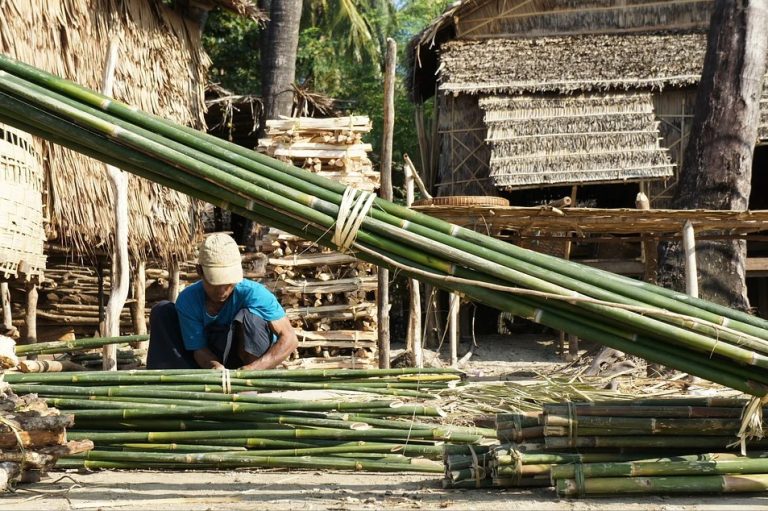
Indigenous peoples use a diverse variety of bamboo species in construction, making adjustments based on the bamboo species available in their living regions, and utilizing different bamboo materials for components such as pillars, roofs, and walls, applying each material according to its specific strengths.
Among the common bamboo species, thorny bamboo and Moso bamboo are frequently used as the base pillars for supporting structures due to their sturdier and thicker characteristics. Not only that, the thorny bamboo, equipped with thorns, is also used for fences to fend off external enemies. On the other hand, the relatively special arrow bamboo, being shorter and thinner, is used for weaving walls; its high density after weaving significantly enhances the overall windproof and cold-resistant capabilities of the building.
The arrow bamboo woven wall pattern also creates a distinct difference between indigenous bamboo architecture and Han Chinese bamboo architecture. Han bamboo architecture mostly uses bamboo poles as the main structure, with walls constructed using the bamboo-and-mud technique, making the overall structure closer to mud-brick architecture. In contrast, most indigenous bamboo architecture consists of pure bamboo and timber structures formed by directly stacking bamboo poles or overlapping halved bamboo tubes, which are then secured by wrapping with rattan. Only a few ethnic groups, such as the Atayal and the more southern Paiwan, have used the bamboo-and-mud wall construction technique.


Indigenous bamboo construction techniques
Because the bamboo poles used in indigenous bamboo construction are directly exposed and left untreated, buildings face more severe insect infestation and corrosion issues compared to wattle and daub walls; therefore, Taiwan's indigenous peoples have developed various bamboo pole preservation techniques to increase the durability of construction bamboo.
- immersion method
Burying bamboo poles in the sand to soak in saltwater, or soaking them directly in water, uses moisture to reduce their starch content and prevent insect infestation and decay. - Smoking method
Before construction, bamboo poles were smoked to prevent decay and insect infestation, or fires were lit directly inside the house to smoke the entire structure. Because some indigenous groups already had hearths inside their homes, they did not smoke the houses beforehand, but instead achieved the anti-decay and anti-insect functions through daily fires.
In addition to increasing the durability of bamboo, Taiwan's indigenous peoples have made further use of the hollow characteristics of Taiwanese bamboo species, developing the so-called "semi-split bamboo pole" technique, which is utilized for roofs and walls. A semi-split bamboo pole refers to splitting a hollow bamboo stalk in half to form two semi-circular pieces in cross-section, which are then joined together concave-to-concave to make the structure more stable.