# Block-like Spacetime
CONCEPT Time is divided into three stages: "past", "present", and "future".
In basic perception, the past never changes again, and the future is at least to some extent open. As time flows, "what once was" has become part of the past relative to the present moment, and a part of the future has become the present. A specific moment called the "present" "moves" from the past toward the future, and this is the meaning of the flow of time. The "present" is not on a timeline, but moves from a genuinely past time point to an equally genuine future time point. The present only constantly changes, and the past and future are merely concepts used to describe this genuine, isolated, and ever-changing "present," rather than being actual time.
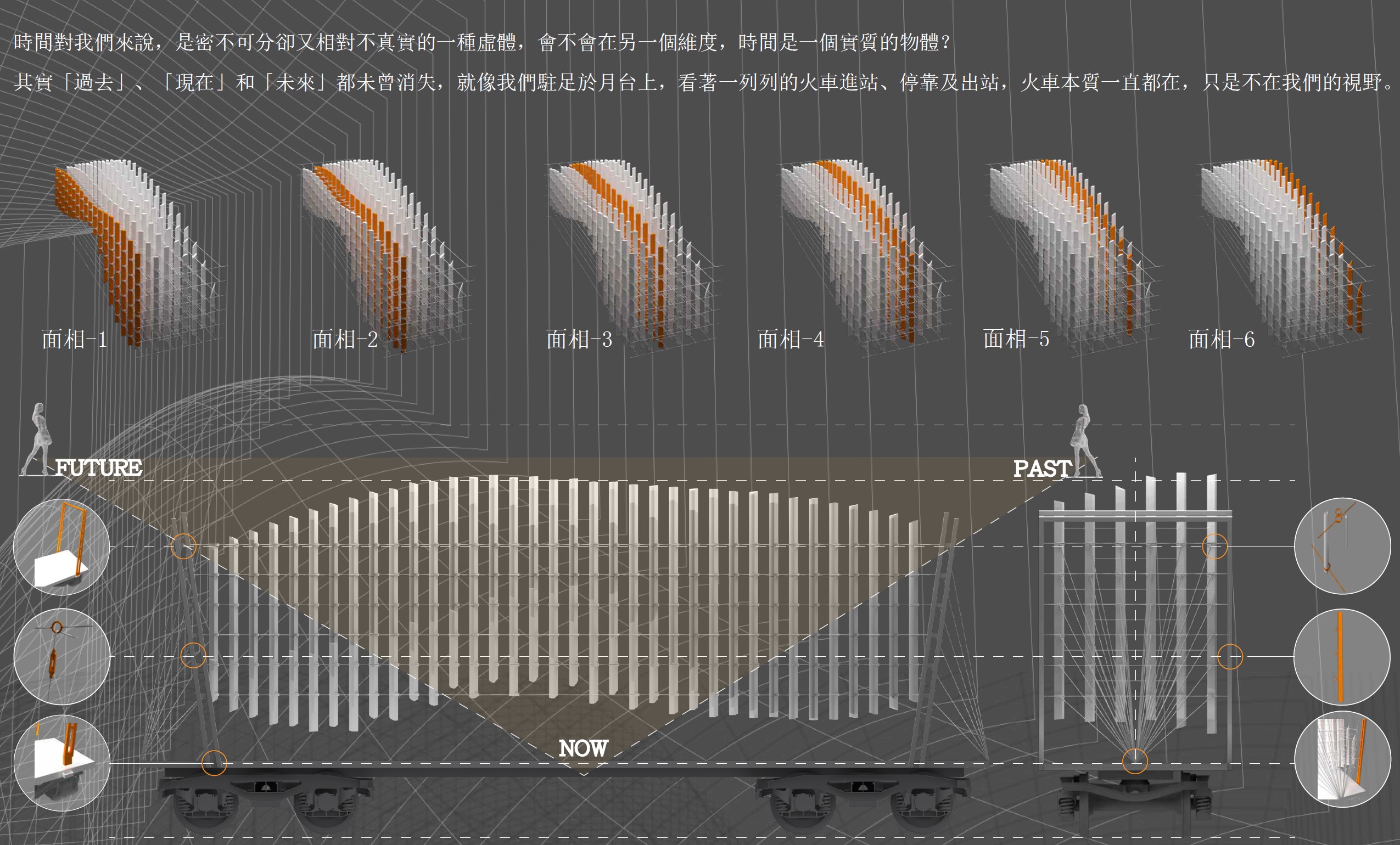
Time is an inseparable yet relatively unreal abstraction to us. Could it be that in another dimension, time is a tangible object?
Actually, the past, the present, and the future have never disappeared. It is just like standing on a railway platform, watching trains pull in, stop, and pull out of the station. The essence of the trains is always there, they are just not within our field of vision.


# Review
The bamboos in the piece itself are parallel to each other and do not touch. In terms of "bamboo construction," they have no direct connection, but that is also fine. Because in practical execution, there will be many detailed designs worth exploring. For instance, with rope hardware, when bamboo is connected with dissimilar materials, how can the joint be made clever and refined? In addition, the frameworks on both sides must be made very aesthetically pleasing. Because the concept of the work is simple, the handling of the details will affect the overall vibe and texture of the piece. Viewers walking around it will directly see them, so the craftsmanship must feel sophisticated. I hope the students will put a lot of care into handling the details. (Fan Cheng-Tsung)
When the theme is clear, it is recommended to further streamline the design. For example, is such a complex and massive suspension structure necessary? Bamboo is lightweight, and since the work is not an enclosure space, even wind won't cause significant damage. However, having so many horizontal lines might weaken the lightweight feel of the bamboo.
Secondly, your design involves processing each bamboo tube so that one side reveals the bamboo skin while the other shows mirror acrylic, meant to present different views from the perspectives of the future, past, and present. However, how exactly are the acrylic and the bamboo to be combined? The method should be made clearer. Alternatively, you could try other approaches, such as splitting one side to expose the bamboo nodes and working inside them, or applying silver foil to the outside of the bamboo tubes. Overall, while preserving the original concept, the imagery and the components should be simplified. (Wang Wen-hsiung)
The most fascinating aspect of this work is the relationship between structure and time. It utilizes the concept of time to create a continuous structural concept, and pragmatically uses standard ironwork commonly found on the market for its realization. The continuity and penetrability of the spatial sensation created by the suspension device align well with the concept, making it a good piece. However, it fails to fully exploit the characteristics of bamboo; the fragmented pieces could look like any material. Additionally, because it is related to time, extending the work and making it longer might yield an even better effect. (Chen Kuan-Fan)
Overall, the work performs clearly, but currently, the portal frames on both sides of the chassis bear the load and then connect the other bamboo pieces. The bamboo itself does not seem to bear the load, failing to utilize its structural characteristics. The work looks simple, but the technical difficulty is relatively high. To make every piece of bamboo look vertical and neat, the process requires constant adjustment because it is always in motion, and the shapes of the structural elements, the thin steel cables, will continuously change. The production process requires careful design. The technical challenges of fabrication are far more difficult than the other two proposals, and I look forward to seeing a breakthrough in technology. (Gan Ming-Yuan)
Regarding the construction characteristics, although the constructive nature of bamboo was not reflected in the work, the piece still reflects the construction methods of bamboo architecture. We asked the students to try to express bamboo's construction methods—such as lashing techniques—in their work as much as possible, so that the piece relates to bamboo construction. (Kao Hsiao-Chien, Yuntech advisor)
The artwork is somewhat like a suspension bridge, where structural design is a key area requiring effort. Imagine a typical suspension bridge: in addition to the ropes above, there are also downward ropes, otherwise it would sway a bit. Therefore, pulling it downward to secure it and create balance and stability is something that could perhaps be considered. The opposite direction might also be interesting, perhaps intentionally allowing it to sway, creating slight movement when the wind blows. (Hsu Pei-Hsiang)
This set has a physical scale model, and you need to grasp a few difficult key points. First, whether the fixed end is secure enough. Special attention must be paid to the control of stable force application points and anchor points. If this is almost successful, the subsequent steps will go much more smoothly. Second, the ropes must be taut, to the point where the tension is "controlled." As for whether the entire object is to swing or be clamped, both can be fine-tuned later. The most crucial thing is that the fixation points must absolutely not shift. Once that is implemented, use the ropes to adjust the geometry and control the tension. The above is an addition regarding situations you might encounter during your future practical work. (Chen Kuan-Fan)