# Builds a Cloud
Concept
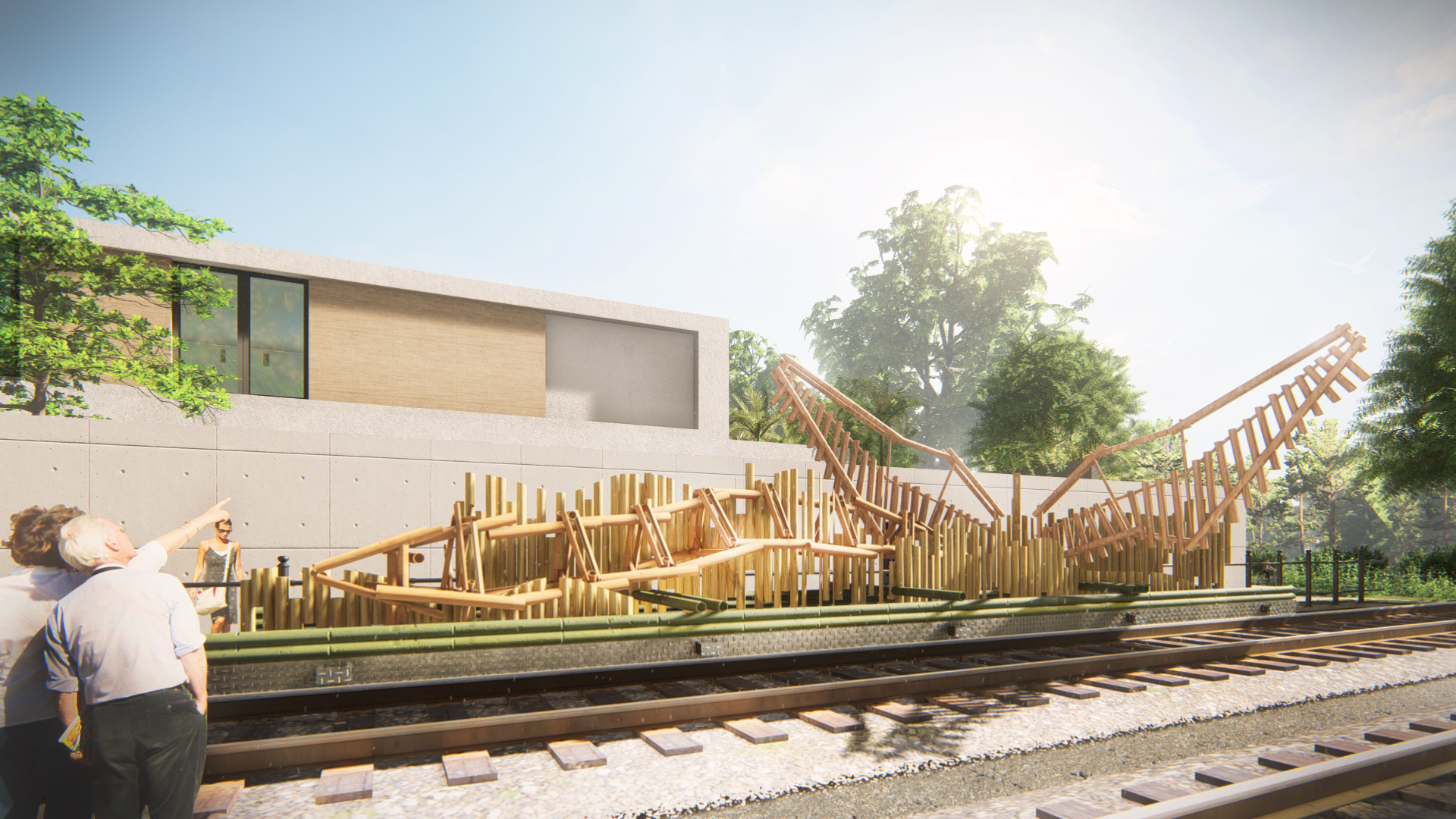
Tourists passing by train can immerse themselves in the warmth of bamboo art, feeling the connection between Zhuqi and Alishan. Through diagonally cut bamboo, it expresses the origin of Zhuqi's place name, while the variations in height and density symbolize the Five Wonders of Alishan. Combined with snakes and birds, it allows viewers to gain a deeper understanding of the local Tsou culture of Alishan.
Floating Clouds and Sunrise.Bamboo Hill.Alishan's Five Wonders (Sunrise, Sea of Clouds, Sacred Trees, Railway, Sunset Glow)
Uhugubirds. Divine birds in Tsou mythology that brought fire during the flood to save their people.
Snakes represent a bad omen in the Tsou culture, which reflects that in modern times, we should reflect on the destruction of nature and thereby promote the conservation of the natural ecosystem.


# Review
Mythology is merely an origin; without the relevant knowledge background, it is difficult to enter directly. Therefore, designers must have the intention of translation—to translate the meaning and culture behind the mythology through architecture, and try to avoid using surface forms directly, which would cause people to only discuss aesthetic symbolism and fail to feel what you want to express. I think there should be an expression after absorbing the mythology, presenting what you want to translate through bamboo materials and structure.
The work has too much interpretive content, combining the floating clouds and sunrise of Alishan, the Owston's white-bellied rat snake (or "uhu" bird), and snakes in terms of approach, attempting to interpret more local characteristics in a single unit (a trolley). However, there is a desire to express too much, which clutters the entire composition. If one doesn't start by looking at the presentation, I actually can't tell which parts are which, nor can I distinguish the concept of the wings from the bamboo below. Is the front part a snake? Or a tunnel? The symbolism is very rich, but the execution could moderately make trade-offs, as so many elements interfere with one another. The visual weight of the current units is too similar, making it hard to see the boundaries between them. You could try using different bamboo materials or construction methods locally, but the hope is still to streamline it a bit. In addition, it currently looks like a mere decoration. Is there a chance to adjust a certain part to give the whole thing a bit of spatial depth and better three-dimensionality, which would correspondingly help distinguish the individual elements? (Wang Wen-hsiung)
Both groups seem to want to make something broad that touches on local elements of Chiayi. But during development, they need to check the overall picture from time to time. Reflection: At the current stage of the design, if a viewer knows nothing about Alishan, would they find it attractive and good? Or do they need to understand Alishan and read the information/descriptions to appreciate the work? This perspective can often be used to assist in making choices. For example, if the final work looks chaotic with a lot of information, assuming I don't understand the subject matter you want to express, the impression it leaves won't be very favorable. When I further understand what you want to express, it feels like using bamboo to convey many things is not easy to receive.
Overall, students should be encouraged to be more confident in making decisions and not try to encompass everything, because that would make the initial scope of subjects to handle too large. After making a decision, next consider how to use material construction to express your decision. Be clear about which path you are on and what your objective is. If you are focusing on a figurative subject, you might need a bit more confidence to decide what specific aspects to focus on—aspects that you view in a certain way, perhaps in a manner that not everyone would think of. (Fan Cheng-Tsung)
It is suggested to reduce the elements; for example, erecting bamboo poles to resemble mountain ridges. They have many lines and are less visually engaging than the other two elements, so they could possibly be reduced, leaving just two elements (wings and snake). The common characteristic of the two elements is the overlapping of bamboo pole members at different angles, which allows them to be combined formally. Similar to the challenge of a spatial truss, how different lengths and angles can form a stable structure, and thinking about how it can go beyond being merely an installation to generate space and a sense of enclosure. For example, the wings could bend to approach the spatial state of eaves and pavilions. Even if a metaphorical approach is used, corresponding one-by-one to the state of feathers will create a greater sense of enclosure. I would suggest combining the snake and the wings to allow the wings to break away from the plane and form some overhead shading, which will help in constructing the space and elevate it beyond the state of a mere installation. (Hsu Pei-Hsuan)
Because myths rely solely on text, there is vast room for imagination regarding imagery. However, when the two works transformed from textual content into actual presentations, I saw a piecing together of many elements, making it difficult to return to the imaginative space of the story itself. I feel there is a misconception: when transforming a story into a presentation of physical construction materials, the two cannot be laid out in such a direct relationship. There is still a need for curation, to clearly articulate the relationship between construction and materials. (Kan Ming-Yuan)